Water in nature is almost always moving, in rivers, in pipes, and in living systems. Yet nearly all studies of water’s molecular structure have been carried out on still water. A new open access pilot study from the Yunosato Aquaphotomics Lab and Kobe University uses near-infrared (NIR) Aquaphotomics to look at water while it flows.
The paper, “Aquaphotomics Investigation of Flow-Induced Changes in Water Molecular Structure”, is published in the MDPI journal Water.
A new way to measure flowing water
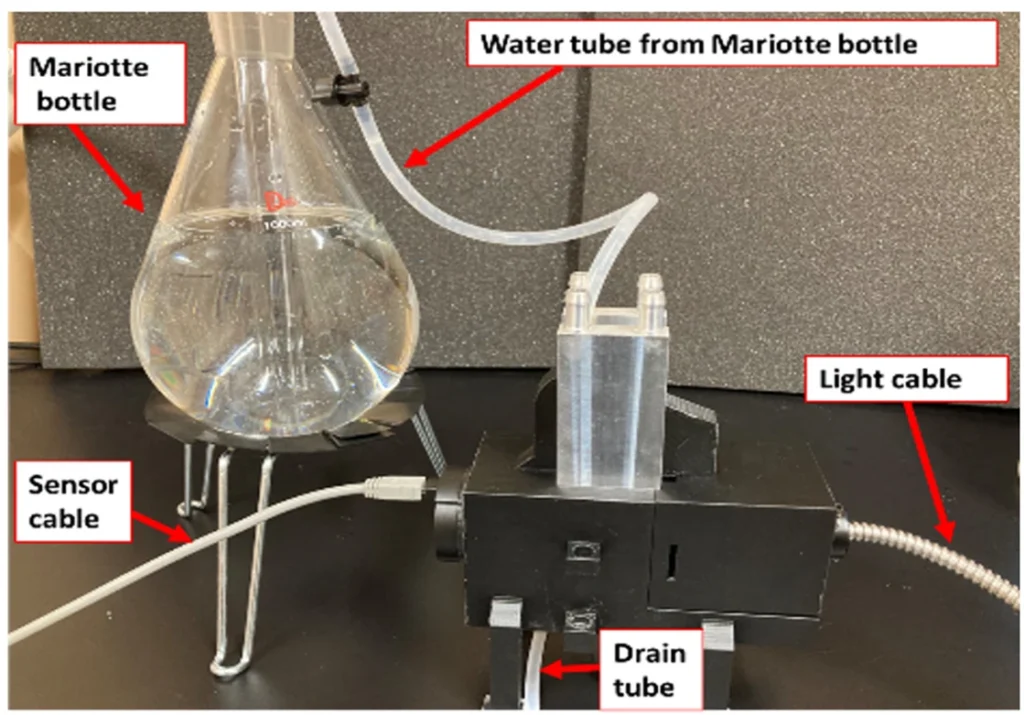
The team built a custom, temperature-controlled flow cuvette system that records NIR spectra in real time as water passes through the measurement cell. Because fresh water flows through continuously, the method also reduces the build-up of light exposure that can affect water during longer measurements of a static sample.
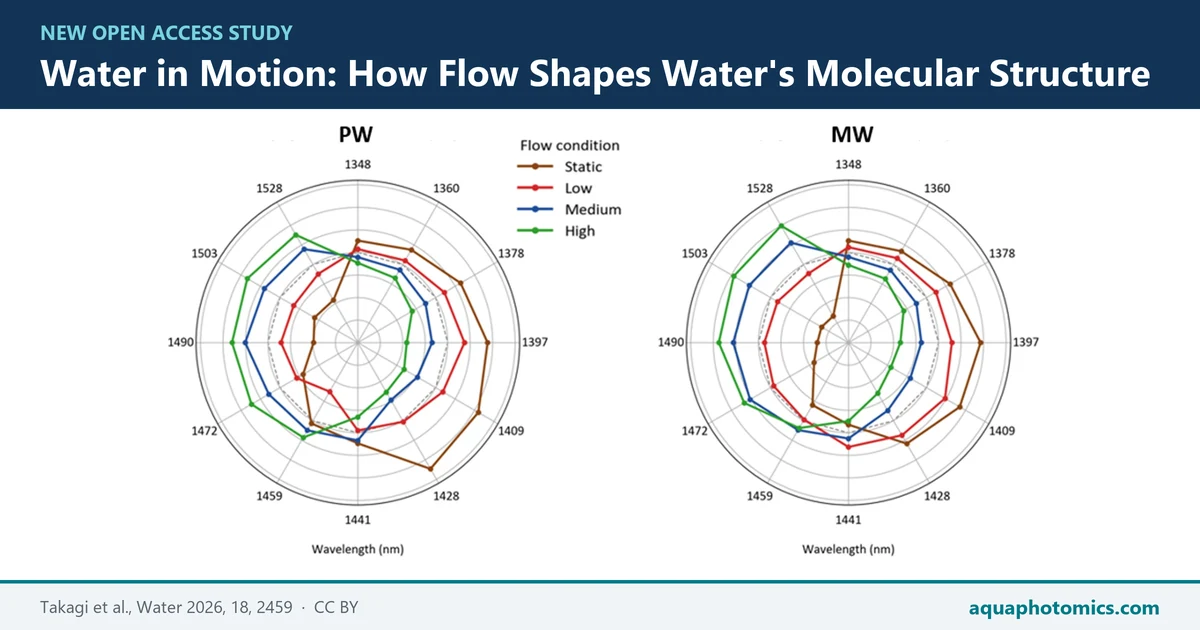
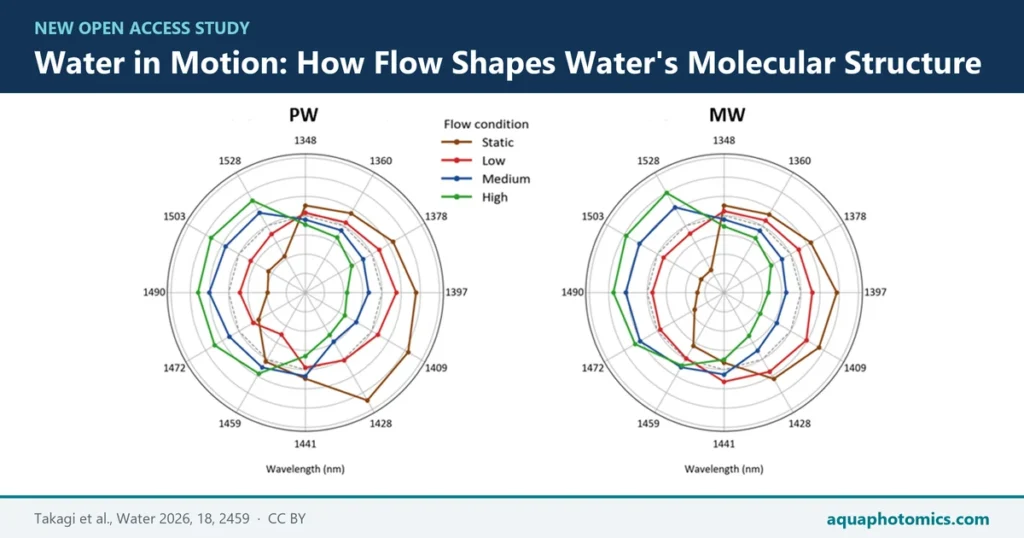
Purified water and natural mineral water were each measured at four flow rates, from static to 10 cm/s. The spectra were analyzed in the first overtone region of water (1300–1600 nm) using multivariate methods and aquagrams.
What the study found
- As flow increased, water structures with stronger hydrogen bonding increased in both types of water, together with a slight drop in sample temperature.
- Natural mineral water responded more smoothly and cooperatively across flow rates, and its temperature became markedly more stable under flow.
- Purified water showed a more irregular response, especially in small water clusters.
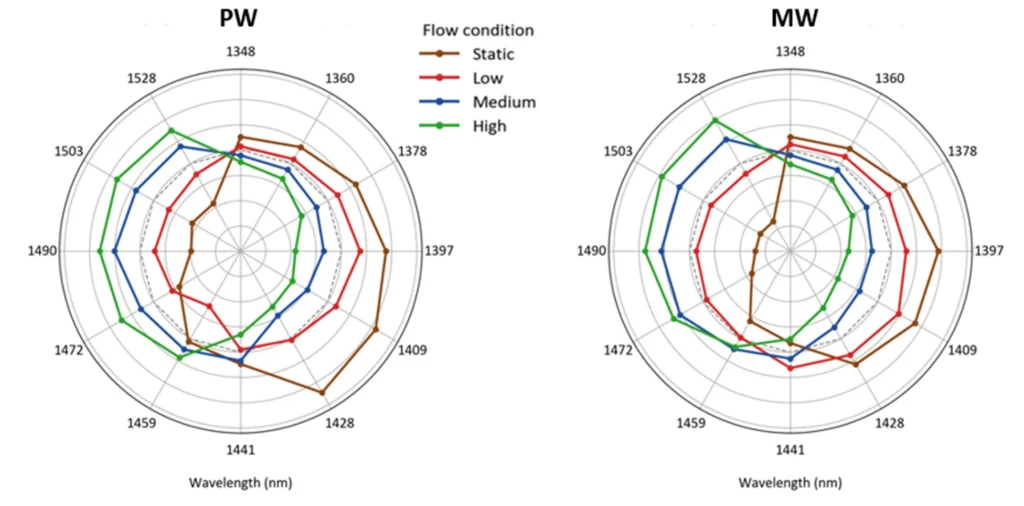
The authors attribute the steadier behavior of mineral water to dissolved minerals, which help form stable hydration shells around ions. They describe flow as a “molecular regulator” of water’s hydrogen-bond network, not only a way of moving water from place to place.
Why it matters
The flow-Aquaphotomics approach offers a way to study dynamic water systems in real time and without disturbing them, with possible uses in areas such as water quality assessment. As a first pilot study with two water types and four flow conditions, it lays the groundwork for future studies with a wider range of waters and flow conditions. The authors also note that the molecular interpretations rest on established aquaphotomics band assignments, and that complementary techniques such as Raman spectroscopy would help confirm them.
Publication details
Takagi R., Stoilov A., Sasaki T., Shigeoka S., Tsenkova R. Aquaphotomics Investigation of Flow-Induced Changes in Water Molecular Structure. Water 2026, 18, 2459.
Read the full open access article: https://doi.org/10.3390/w18192459
Figure: Takagi et al., Water 2026, 18, 2459, CC BY.