Author: admin

  • Aquaphotomics Open Lecture on November 16, 2024

    Aquaphotomics Open Lecture on November 16, 2024

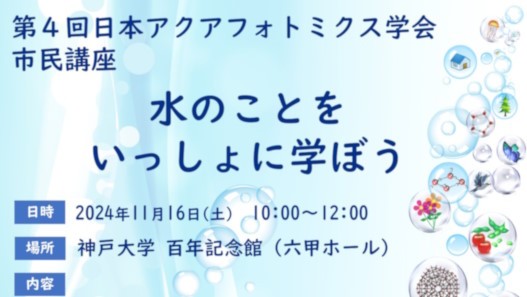
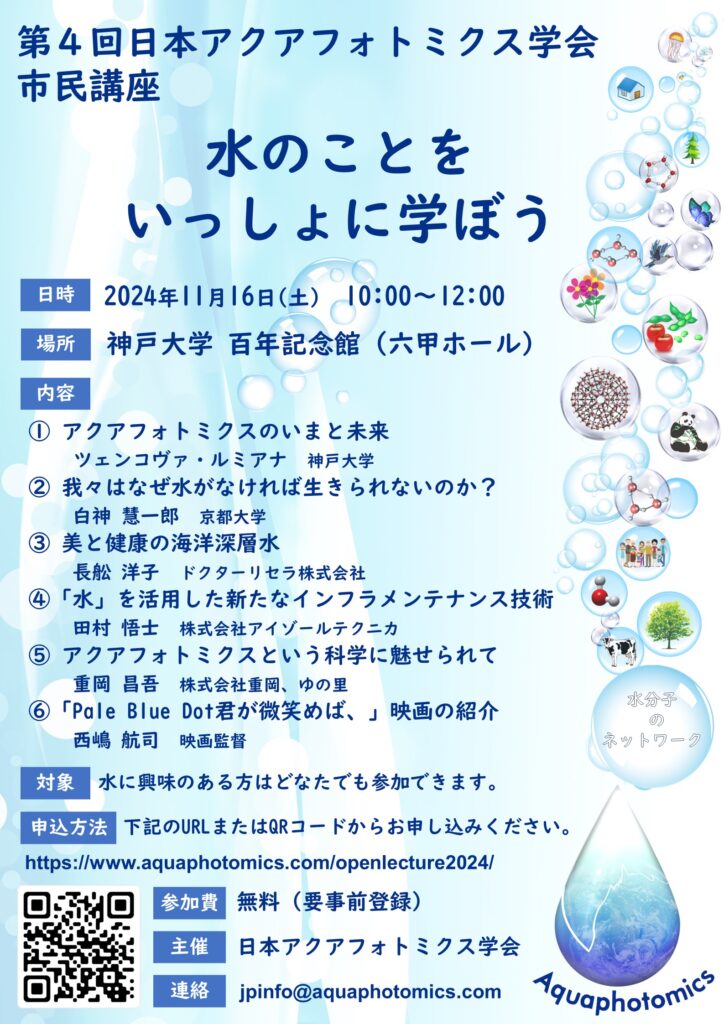
    The Japan Aquaphotomics Society will hold a ‘Open Lecture’ for the general public on Saturday, November 16, 2024, from 10:00 a.m. to 12:00 p.m. The lecture will be conducted in Japanese, and anyone interested in water is welcome to attend, with participation available both in-person and online.

    Admission is free, but pre-registration is required. We warmly invite you to join us!

    https://aquaphotomics.com/japanconference/openlecture2024/

    —————————————————————————————
    2024年11月16日(土)10:00~12:00、日本アクアフォトミクス学会より一般市民向けの「市民講座」を開催いたします。この講座は水に興味のある方ならどなたでもご参加いただけ、会場およびオンラインでの参加が可能です。

    参加費は無料ですが、事前登録が必要です。ぜひお気軽にご参加ください。

    https://aquaphotomics.com/japanconference/openlecture2024/

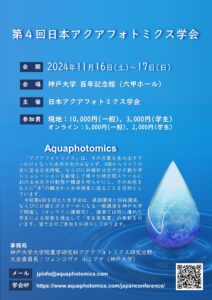
  • The 4th Japanese Aquaphotomics Conference on November 16 & 17, 2024

    The 4th Japanese Aquaphotomics Conference on November 16 & 17, 2024

    {:en}

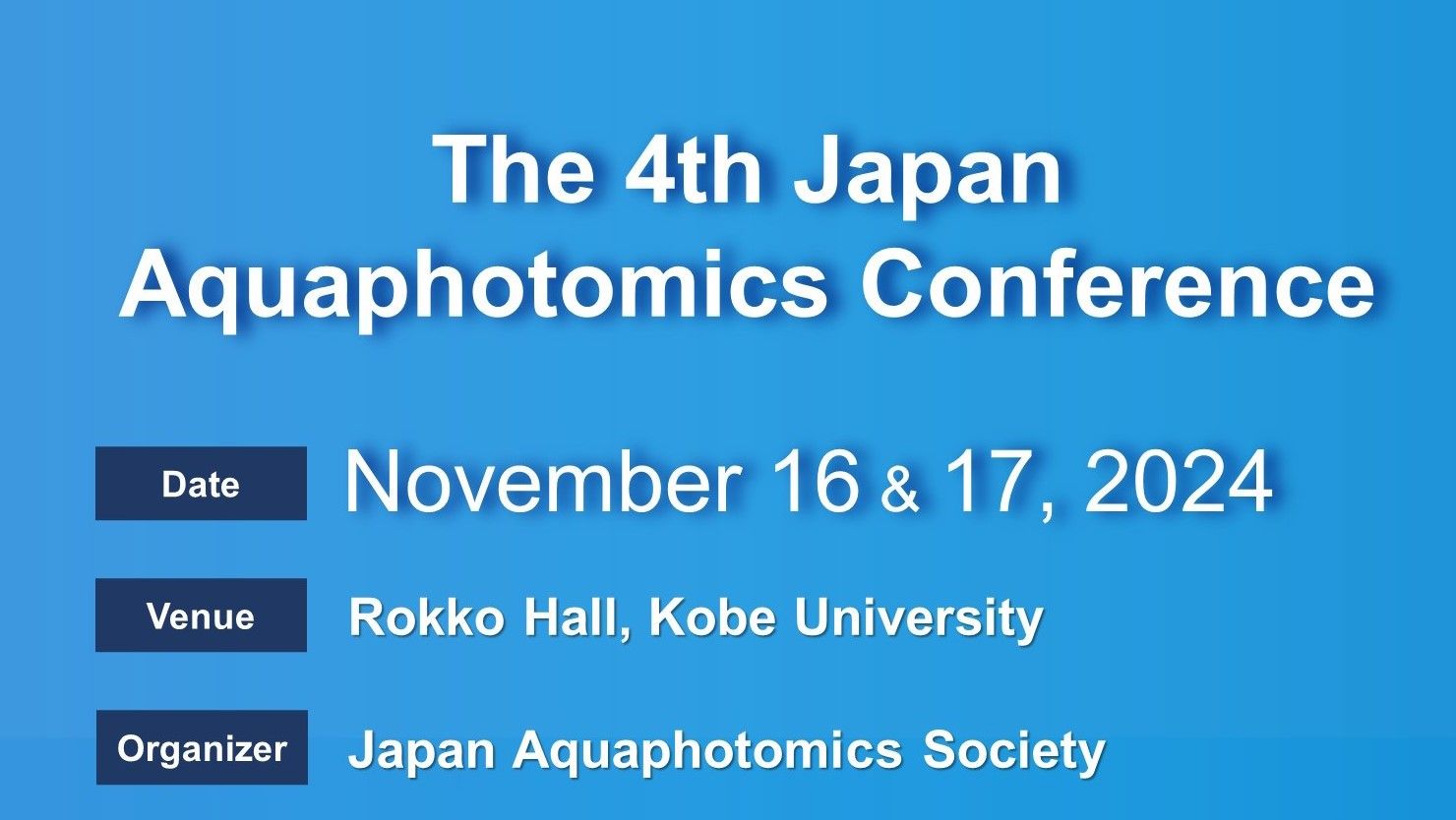
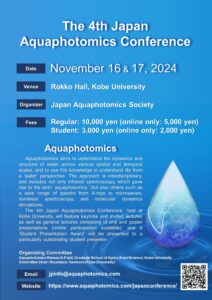
    The 4th Japan Aquaphotomics Conference” (https://aquaphotomics.com/japanconference), which will be held on November 16-17, 2024, at Kobe University in a hybrid format. Please note that this event will be conducted primarily in Japanese. However, if you are interested in joining online, you may take advantage of Zoom’s automatic translated captions feature to follow the discussions. Below is the detailed information in Japanese for those attending locally.

    このたび、「第4回日本アクアフォトミクス学会」を2024年11月16日(土)・17日(日)の2日間、神戸大学において開催いたします。つきましては皆様にご参加いただきたく、ご案内申し上げます。
    本会議はオンライン参加も可能なハイブリッド形式で行われ、光を用いた水の探究や、水が様々な水溶液および生体システムにおいて果たす多様な役割と機能性に関する幅広いトピックを取り上げます。プログラムには、基調講演、招待講演、一般講演(口頭およびポスター発表)が含まれます。また、特に優れた学生発表には「学生発表賞」を授与いたします。
    ——————————
    登録フォームおよび学会に関するその他の情報は、以下のウェブサイトをご覧ください:
    https://aquaphotomics.com/japanconference

    ご質問やご不明な点がございましたら、お気軽に [email protected] までご連絡ください。
    皆様のご参加を心よりお待ち申し上げております。

  • Discover the Beauty of Water and Life in new documentary “Pale Blue Dot”

    Discover the Beauty of Water and Life in new documentary “Pale Blue Dot”

    We are excited to present the new documentary “Pale Blue Dot,” which explores the profound connections among water, light, and life.


    Featuring the founder of Aquaphotomics Prof. Roumiana Tsenkova, the Chief Priests of Tenkawa Shrine in Nara, and renowned physicist Haruo Saji, this film beautifully complements our work in uncovering the mysteries of water. Please join us in this cinematic journey that captures Earth’s delicate beauty and the pivotal role of water in sustaining life.

    For more information, please visit the official website of Pale Blue Dot.

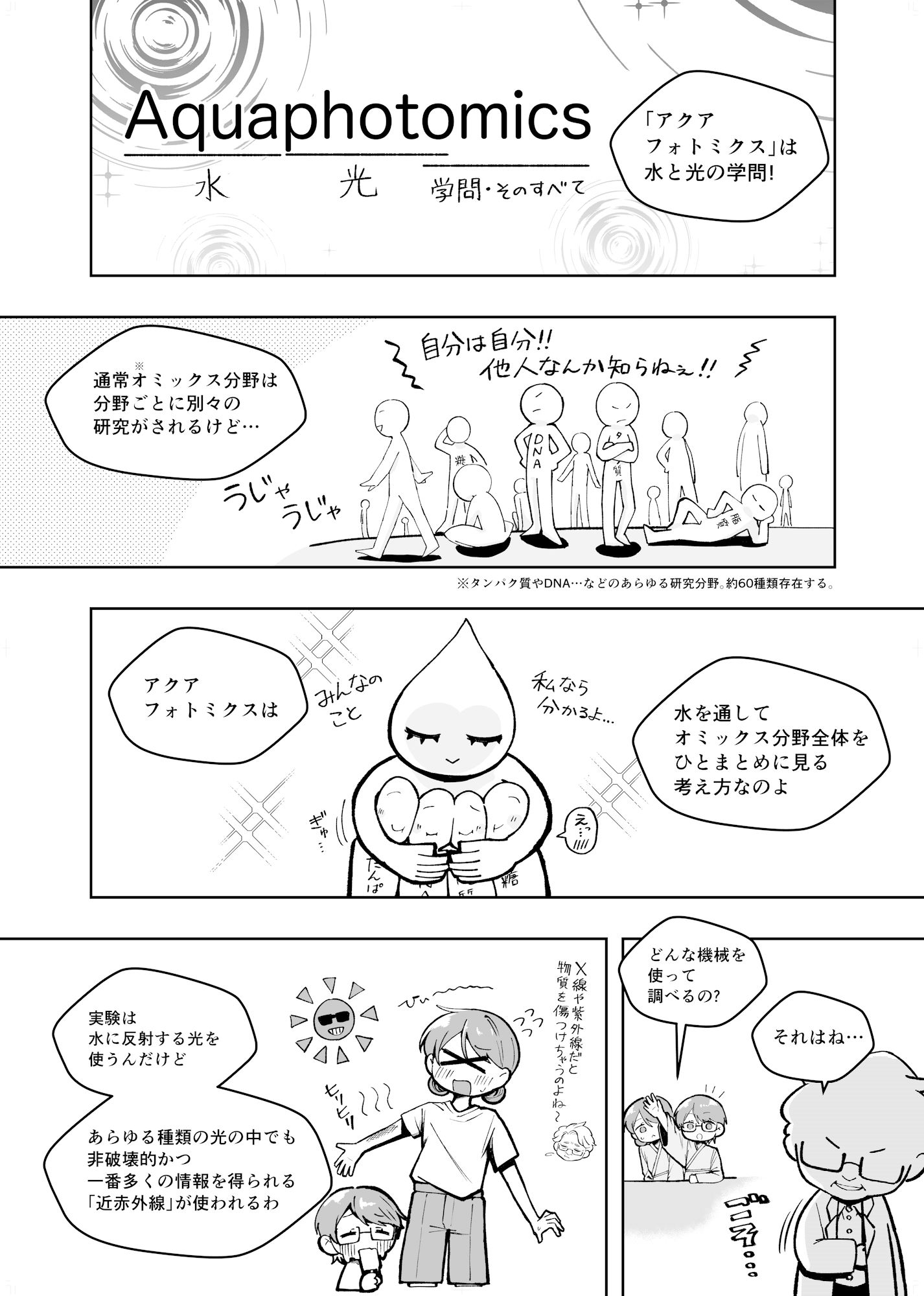
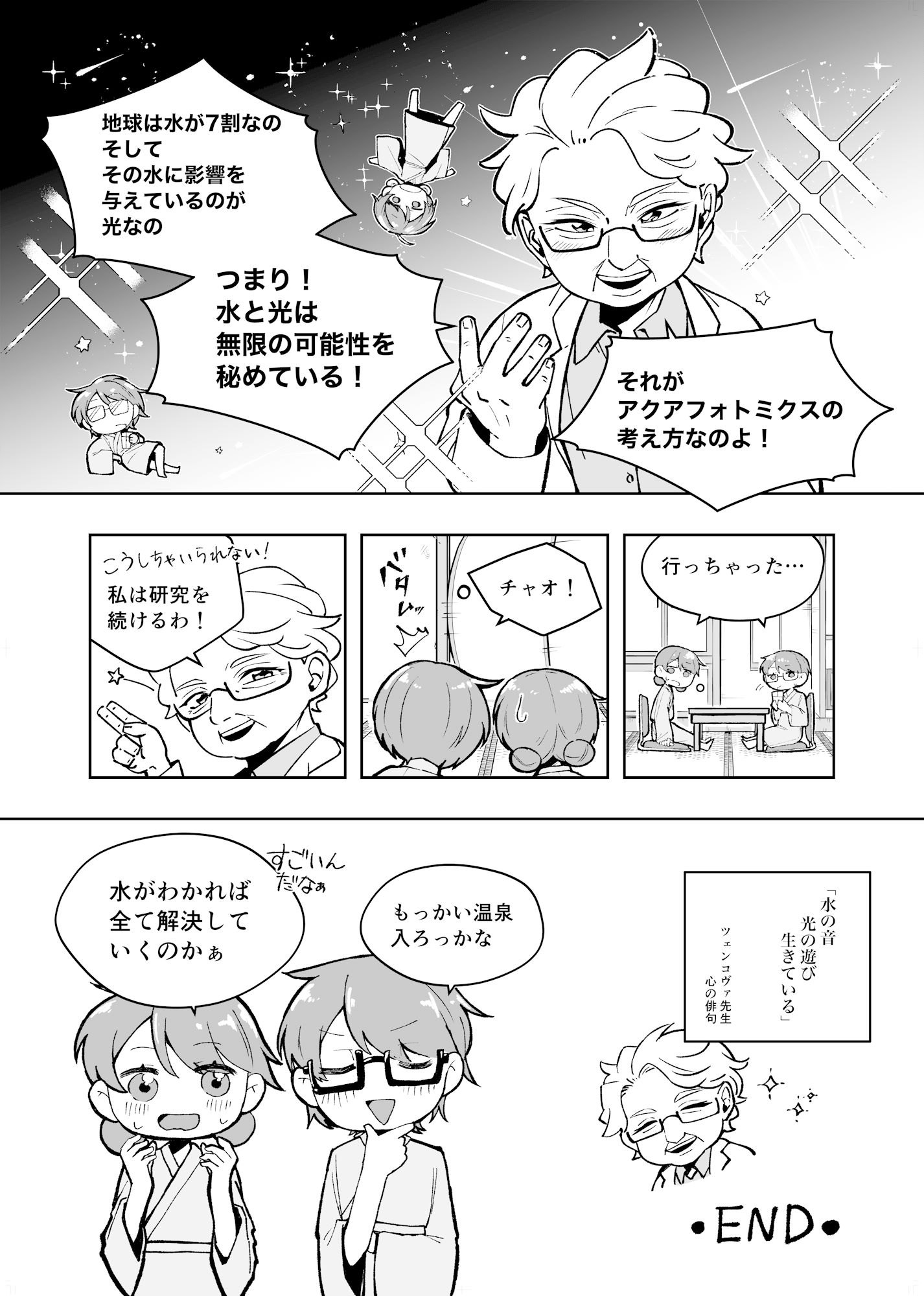
  • Introducing Aquaphotomics: A Beautiful Japanese Comic on the Science of Water

    Introducing Aquaphotomics: A Beautiful Japanese Comic on the Science of Water

    We had the pleasure of receiving a beautifully crafted Japanese comic that introduces the basics of Aquaphotomics in a visually engaging way. With permission from the artists, we are excited to share these pages with you. Below are the four pages of the comic. (Click to enlarge the images.)

    What do you think of the comic? Feel free to share your thoughts or questions in the comments below. And don’t forget to share this post with others who might be interested in Aquaphotomics!

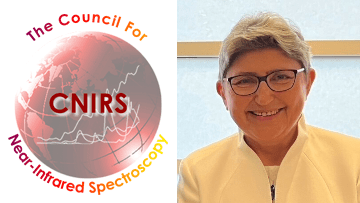
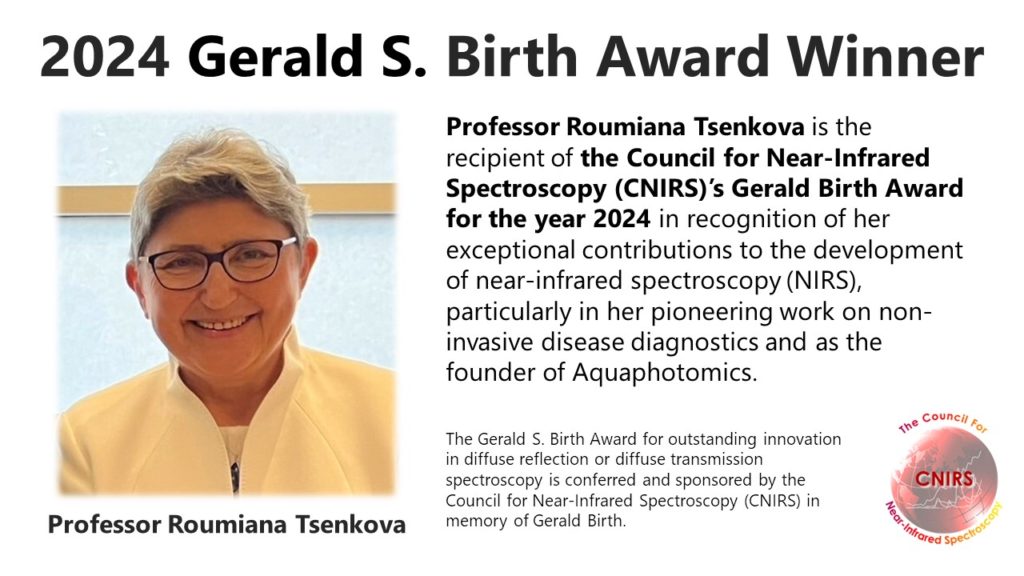
  • Professor Roumiana Tsenkova has been awarded the Council for Near-Infrared Spectroscopy (CNIRS)’s Gerald Birth Award for 2024

    Professor Roumiana Tsenkova has been awarded the Council for Near-Infrared Spectroscopy (CNIRS)’s Gerald Birth Award for 2024

    We are delighted to report that Professor Roumiana Tsenkova was awarded the Council for Near-Infrared Spectroscopy (CNIRS)’s Gerald Birth Award for 2024 in recognition of her exceptional contributions to the development of near-infrared spectroscopy (NIRS), particularly through her pioneering work on non-invasive disease diagnostics and as the founder of Aquaphotomics.

    In 2005, Prof. R. Tsenkova proposed for the first time newly identified water absorbance bands and spectral patterns specific to biological and aqueous systems, and she introduced the concept of building a database, the Aquaphotome, to be used for diagnosis, quantification, and functional characterization at the system level. This work led to the discovery of the phenomenon of water acting as a collective mirror of matter and energy.

    The award was conferred especially in recognition of Professor Tsenkova and her collaborators’ Aquaphotomics research on elucidating water activity in food.*1 The significance of this research lies in clarifying the correlation between absorbance in the water vapor bands and water activity, demonstrating the definition of water activity, and presenting water spectral patterns as a new dynamic multidimensional biomarker for food preservation.

    Read the announcement of the 2024 Gerald S. Birth Award Winner

    The award ceremony was held at the International Diffuse Reflectance Conference at the University of Tennessee, USA, on August 1st, 2024, and the awardee presentation took place on July 31st, 2024. On the same day, Professor Tsenkova and Associate Professor Jelena Muncan served as session chairs for the Aquaphotomics session.

    International Diffuse Reflectance Conference (IDRC) July 27 – August 2, 2024

    The Gerald Birth Award

    The Gerald S. Birth Award is a distinguished honor bestowed by the Council for Near-Infrared Spectroscopy (CNIRS) to recognize outstanding innovation in the fields of diffuse reflection or diffuse transmission spectroscopy. Established in memory of Dr. Gerald S. Birth, the founder of the International Diffuse Reflectance Conference (IDRC), this award celebrates significant advancements and contributions to the art and science of Near Infrared (NIR) spectroscopy.

    Dr. Birth made notable contributions to the development of instrumentation technologies related to diffuse reflectance, and the award is conferred biennially to researchers whose work exemplifies groundbreaking progress in these areas. Eligible candidates are those conducting research in the visible, NIR, or mid-IR regions of diffuse reflection or transmission spectroscopy.

    *1 Malegori, C., Muncan, J., Mustorgi, E., Tsenkova, R. and Oliveri, P. Analysing the Water Spectral Pattern by Near-Infrared Spectroscopy and Chemometrics as a Dynamic Multidimensional Biomarker in Preservation: Rice Germ Storage Monitoring. Spectrochimica Acta Part A: Molecular and Biomolecular Spectroscopy (IF 4.4), p.120396, 2022. https://doi.org/10.1016/j.saa.2021.120396

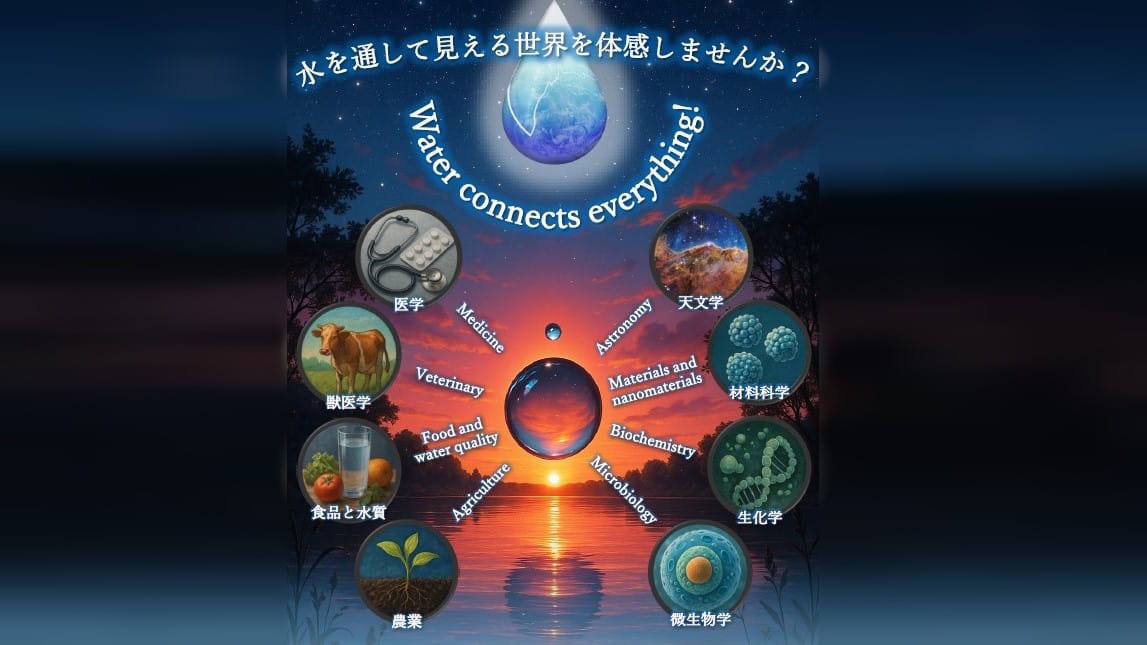
  • Important Announcement: Aquaphotomics International Conference in 2025

    Important Announcement: Aquaphotomics International Conference in 2025

    Dear Friends and Colleagues,

    We hope this message finds you well. We have an important update regarding our scheduled conference.

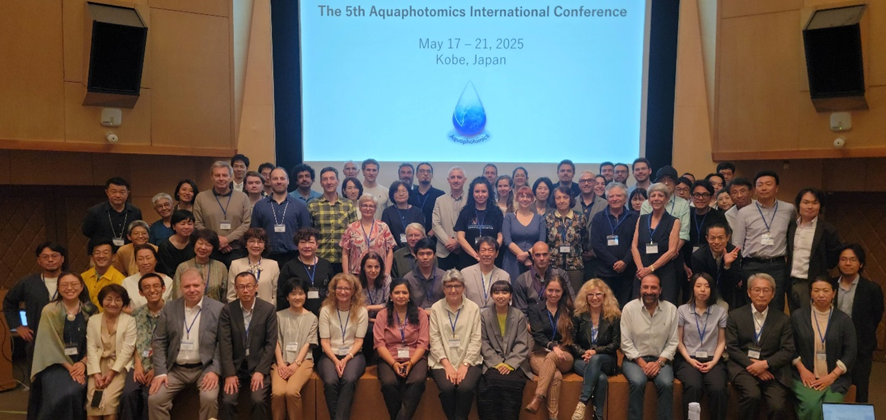
    This year marks a significant milestone as we celebrate the 20th Anniversary of the announcement of Aquaphotomics. In honor of this occasion, we are thrilled to announce that the 5th Aquaphotomics International Conference has been rescheduled to May 2025 to align with these celebrations.

    The open lecture and the Aquaphotomics school are set for May 17th, followed by the Aquaphotomics International Conference at Kobe University on the 18th and 19th. May 20st will serve as a travel day, with a study tour scheduled for the 21st. This strategic rescheduling aligns our event with the much-anticipated EXPO OSAKA 2025, providing a unique and comprehensive experience in Japan.

    Aquaphotomics will be participating in the EXPO OSAKA 2025 exhibition in various ways, and we would like to offer a unique opportunity to our delegates to immerse themselves in a world-class cultural and technological expo, in addition to attending the conference. Such coordination will also allow international participants to make the most of their stay in Japan, minimizing travel constraints and maximizing cultural and professional enrichment.

    We will continue to share updates through our website and direct communications. Please stay tuned for more information on the program, keynote speakers, and special events.

    This decision opens up new avenues for collaboration, learning, and exploration at both our conference and EXPO OSAKA 2025. I would be grateful for your understanding and support on this matter.

    For more information: https://aquaphotomics.com/conference/

    Warmest regards,
    Roumiana Tsenkova
    President and Founder of Aquaphotomics International Society

    (last updated: December 2024)

  • Aquaphotomics Spring Webinar ~ Physics of the Floating Water Bridge ~

    Aquaphotomics Spring Webinar ~ Physics of the Floating Water Bridge ~

    Recording

    Special thanks to Dr. Fuchs for his enlighting lecture!
    If you have any questions or comments, feel free to share them in the comments section of the YouTube video, and we’ll ensure they reach Dr. Fuchs.


    Dear friends and colleagues,

    This month we are delighted and honored to have Dr. Elmar C. Fuchs, a distinguished researcher specializing in experimental physics and physical chemistry of water as a speaker at our Aquaphotomics Spring Webinar.


    Elmar C. Fuchs, Dipl.-Ing. Dr. techn., is a renowened scientist born in Austria, with an expertise in experimental physics and physical chemistry of water. Since September 2008 he is employed at Wetsus, the European Centre of Excellence for Sustainable Water Technology, where he has progressed from PostDoc to Theme Coordinator and Programme Manager, and currently heads the Wetsus Business Acquisition & Collaboration Team as part of the scientific management of Wetsus. He has over 50 peer-reviewed publications, and has been extensively involved in research and technology development at Wetsus. His work includes collaborations in laser laboratories, neutron scattering studies, NMR measurements and experimental approaches to quantum field theory of water. Contributions to the scientific literature are most diverse and include papers on microbial calcium carbonate precipitation, solar eclipses, liquid-liquid phase transitions in water, and studies of the dynamics of electrically confined water. He has received multiple awards, honours and recognitions of his works in international journals. Interesting, lesser known-facts about Dr. Fuchs is that he has many talents and interestes – he is fluent in German, English and Dutch, and has a basic knowledge of Italian and Latin. He is a great admirer of Japan and practices Asian martial arts iaido and kendo, enjoys artistic pursuits such as music, painting, photography, poetry and astronomy. You can even listen to his music on Spotify!

    In this webinar, Dr. Fuchs will talk about the intriguing phenomenon of the floating water bridge.


    When two beakers are filled with pure water and a DC voltage of 15-20kV is applied via two noble metal electrodes, a liquid bridge forms between these beakers. Electrohydrodynamics can be used to describe the liquid movements, and on the molecular scale, a liquid/liquid second-order phase transition takes place due to phonon coupling. Pure water electrolysis takes place and allows the production of non-stoichiometric, protonically charged water.


    Another lesser-known fact about Dr. Fuchs is that when he published for the first time results of his research on the floating water bridge (The floating water bridge, Journal of Physics D: Applied Physics, 2007) in just two days, this paper got so much attention that he was overwhelmed with emails and phone calls from all around the world, and he was called to do an interview about it for Nature, the magazine.


    Therefore, it is our special honor, pleasure and privilege that during this webinar, he will share his story about the floating water bridge and present his latest findings.


    Please mark your calendars for the webinar on March 26th 5PM JST and be sure not to miss it. The webinar will be held, as usual, on the Zoom platform and is free for all who wish to attend. To register, please use the “Sign up” form provided below.

    We look forward to your participation!


    Aquaphotomics Spring Webinar – Schedule

    Time & Date

    Date: 2024/03/26 (Tuesday)
    Start: Japan Time (JST) 5:00 PM / CET 9AM / EST 3AM
    End: Japan Time (JST) 6:00 PM / CET 10AM / EST 4AM

  • Our Research Project announced by JAXA

    Our Research Project announced by JAXA

    JAXA stands for the Japan Aerospace Exploration Agency, Government research institution in Japan.

    Our project for joint research with JAXA titled “Development of technology for monitoring the dynamics of water molecules under low and microgravity conditions”, which started in November last year, has been press released.

    In English:

    https://www.ihub-tansa.jaxa.jp/english/RFP_announcement10_en.html

    Research Topic: “Development of technology for monitoring the dynamics of water molecules under low and microgravity conditions”

  • Aquaphotomics Winter Webinar ~ Coherent Water as a Negentropic Engine ~

    Aquaphotomics Winter Webinar ~ Coherent Water as a Negentropic Engine ~

    Recording & Presentation Slides

    Special thanks to Prof. Guiliani for generously providing access to the presentation slides.

    Download Presentation Slides


    Dear friends and colleagues,

    We are delighted to extend an invitation to the first aquaphotomics webinar of 2024! Join us as we host the distinguished Professor, Dr. Livio Giuliani, a renowned scientist in the field of water science.

    Prof. Giuliani, having earned his doctorate cum laude in 1974 from Sapienza University of Rome’s Institute of Mathematics, brings a wealth of experience. Over the years, he held key roles, including Senior Researcher at ISPESL/INAIL (Italian Ministry of Health) and Chief of the Radiation and Ultrasounds Environmental Pollution Lab (1998-2014). Prof. Giuliani played a pivotal role in formulating exposure limits to electromagnetic fields (EMF), with his “ISPESL Proposal” adopted by the Italian Government in 1998 and now followed by 10 other countries in Europe. As a co-founder and spokesman of the International Commission for Electromagnetic Safety (ICEMS, www.icems.eu), he has contributed significantly to groundbreaking research on the effects of electromagnetic fields (EMFs).

    Prof. Giuliani’s research work transitioned from an early focus on Ionizing Radiation dosimetry to EMF protection in 1997. Collaborations with Emilio Del Giudice and Mikhail Zhadin directed his attention to studying the behavior of aqueous solutions under Extremely Low Frequencies (ELFs), revealing the Ion Cyclotron Resonance (ICR) effect. The subsequent investigations, including studies with various researchers, unveiled the concurrent mechanism of protonation of water due to ICR of hydronium hydrates and the discovery of cations transport through floating water bridges. Since 2006, his research has exclusively focused on describing the effects of ICR on normal and cancer cells, and on bacteria, modulating antibiotic resistance. A significant outcome in 2022 was the publication of successful results from a clinical test, confirming the acupuncture theory proposed by Brizhik, Del Giudice, Maric, Oehler, Popp, and Schlecbusch.

    Prof. Giuliani’s illustrious scientific career has played pivotal roles in regulatory advocacy and ground-breaking research in electromagnetism, specifically in unveiling the profound role that water plays. We are delighted to announce that he will be the one to open this year’s aquaphotomics webinar series.

    Please mark this date and time in your calendars, and join us on 27th February, 5pm JST. To join the session, simply sign up for attendance using the provided “Sign Up” form. The event, as always, is free for all who wish to participate.

    Don’t miss out on this enriching experience! Whether your expertise lies in water studies, aquaphotomics, or spectroscopy, Prof. Giuliani’s presentation is sure to captivate and inspire.

    We look forward to seeing you!


    Aquaphotomics Winter Webinar – Schedule

    Time & Date

    Date: 2024/02/27 (Tuesday)
    Start: Japan Time (JST) 5:00 PM / CET 9AM / EST 3AM
    End: Japan Time (JST) 6:00 PM / CET 10AM / EST 4AM

  • The 3rd Aquaphotomics European Conference

    The 3rd Aquaphotomics European Conference

    The 3rd Aquaphotomics European Conference, was this year organized collaboratively by the Italian Society of near-infrared Spectroscopy (SISNIR  https://www.sisnir.org/ ) and The Aquaphotomics International Society and it took place in the majestic and timeless city of Rome, Italy.

    Founded in Lodi on December 13, 2006, SISNIR today counts over 100 members. As one of the largest and most active NIR societies globally, its objectives include promoting scientific knowledge of NIRS, organizing events such as the biennial NIRITALIA Symposium, and supporting the active participation of young researchers in international conferences to enhance Italy’s contribution to the scientific community.

    Figure 1. The 3rd Aquaphotomics European Conference, this year was held in Rome, Italy.

    With the support of the Italian NIR community, the 3rd Aquaphotomics European Conference was a wonderful opportunity to reunite after enduring an extended period of travel restrictions and limited chances to meet. This gathering allowed us to reconnect with old friends and engage with the emerging generations of aquaphotomics researchers. Together, we embarked on a journey to appreciate the timeless beauty of the Roman city while indulging in the world’s finest pizza, savoring the most exquisite gelato, and engaging in delightful conversations over cups of a strong espresso.

    The Conference extended for a duration of four days, commencing with the Summer School on Aquaphotomics held on September 1st and 2nd. This specialized training program was designed to acquaint researchers (most of them) in the field of NIR spectroscopy and chemometrics and some other fields with the fundamental aspects of this “omics” discipline.

    The first day of school was opened by Prof. Dr Zoltan Kovacs, from Hungarian University of Agriculture and Life Sciences (MATE) in Budapest, Hungary. Prof. Kovacs began by delving into the current global and European developments in aquaphotomics, tracing its evolution since its inception by Prof. Dr Roumiana Tsenkova in Japan. He also shed light on its current fourth-generation advancements and discussed the manifold applications of aquaphotomics.

    Figure 2. The 3rd Aquaphotomics European Conference was held at Casa la Salle, a historic former monastery nestled in the heart of Rome, from September 1st to 4th. The conference attracted 50 participants from approximately 10 different countries.

    The central theme of the first day revolved around aquaphotomics applications, further expounded upon by Assistant Prof. Cristina Malegori from DIFAR University in Genoa, Italy. Her presentation, titled “Applications – Water is Everywhere,” unveiled numerous practical opportunities and imparted essential know-how in this field. Concluding the application-focused lectures, Dr John-Lewis Zinia Zakuu, Lecturer from Department of Food Science and Technology, Faculty of BioSciences, Kwame Nkrumah University of Science and Technology in Ghana, delivered a presentation on “Aquaphotomics in the Agro/Food Field.” Dr Zakuu exemplifies the “third generation” of aquaphotomics researchers, having pursued aquaphotomics during his doctoral studies under the guidance of Prof. Kovacs in Hungary, who himself was a post-doctoral fellow of Prof. R. Tsenkova. Dr. Zakuu returned to Ghana after completing his PhD and assumed the roles of Chairman of the Laboratory Committee and Assistant Exams Officer at the Department of Food Science and Technology, while simultaneously establishing his own aquaphotomics research group in Ghana.

    Figure 3. The first session of the Aquaphotomics Summer School featured prominent figures in the field: Prof. Dr Zoltan Kovacs, Associate Prof. Cristina Malegori, and Lecturer Dr John-Lewis Zinia Zakuu.  They provided invaluable insights into the current state of the art in the field of aquaphotomics and shared their rich experiences spanning a multitude of applications.

    The second day of the workshop delved deeper into the chemistry and physics of water, focusing, also, on practical aspects related to experimental improvement and data analysis. Dr Antonella De Ninno, representing the ENEA (Italian National Agency for New Technologies, Energy, and Sustainable Economic Development), started the second day of the event with a lecture on the chemistry of water and water vibrational spectroscopy. Subsequently, Associate Prof. Jelena Muncan, from the Aquaphotomics Research Department in Kobe, Japan, provided insights into near-infrared spectroscopy and its pivotal role in the development of aquaphotomics. She offered practical guidance, drawing from her own experiences, including instrument selection, signal quality assessment, experimental procedures, and data analysis techniques tailored to aquaphotomics.

    The subsequent two lectures built upon this foundation. Prof. Dr Federico Marini, a renowned expert from La Sapienza University in Rome, specializing in chemometrics and spectral data analysis, elucidated various data preprocessing strategies essential for aquaphotomics. He underscored the significance of recently developed preprocessing techniques designed specifically for addressing data analysis challenges in the field of aquaphotomics. The school concluded with a lecture by Bernhard Pollner MD, Consultant and Data Analyst, who introduced the ‘aquap2’ package, a specialized tool that he developed together with Prof. Kovacs at Kobe University for aquaphotomics data analysis within the R software environment. He effectively demonstrated the package’s capabilities with numerous examples and practical guides, emphasizing its customized features that not only accelerate the entire analysis process but also make it a pivotal tool in supporting the education of the aquaphotomics discipline.

    Figure 4. Snippets from the second day of the Aquaphotomics Summer School. From left to right: Dr Antonella de Ninno, Assoc. Prof. Dr Jelena Muncan, Prof. Dr Federico Marini and Bernhard Pollner, MD, Consultant.

    That same day, in the evening The Conference was officially opened by a lecture of Prof. Dr Roumiana Tsenkova. The lecture titled “Aquaphotomics – New Integrative Science, Technology and Educational Platform” spoke about her vision of aquaphotomics being a common platform for three important directions of development that include fundamental research aimed at discovering and explaining the phenomena related to water-light interaction, technological development that naturally is a consequences of harnessing the newly acquired knowledge, and lastly – a necessary and fundamental need to share this new knowledge not only within the scientific community, but making it available to everyone and hopefully exert the influence on the societal values and future social trends.

    She also shared some intriguing new insights that have recently captured her attention, exploring the fascinating intersection of quantum phenomena and the role of water in consciousness. She highlighted the emergence of “laser-like” and “hologram-like” phenomena arising from the unique properties of water and within microtubules as an example. Prof. Tsenkova emphasized that aquaphotomics extends beyond being merely a field of science, technology, and education—it’s more of a “way of living.” She introduced her Japanese translation of the name “Aquaphotomics” as “Mi-Kou-Do,” where “Mi” means water, “Kou” means light and “Do” means the Way which roughly translates to “The road of Water and Light”.

    Figure 5. Official opening of the Conference by a lecture of the aquaphotomics founder Prof. Dr Roumiana Tsenkova.

    Over the next two days, the conference featured two keynote lectures, ten oral presentations and a poster session.

    The first keynote lecture was delivered by Dr Tiziana Cattaneo, from CREA in Italy, a Research Center for Engineering and Food Transformation, the Department in Milan. Dr Cattaneo is widely regarded as a pioneer and veteran in the field of aquaphotomics. During her presentation, she eloquently traced her research journey, starting from her earliest experiences with aquaphotomics and highlighting numerous developmental milestones that her research group has contributed to over the years.

    Figure 6. Faces of aquaphotomics – snippets of speakers at the 3rd European Aquaphotomics Conference

    She is an exemplary aquaphotomics researcher who has made significant contributions to the field, not only advancing aquaphotomics as a science and technology with profound implications for food production and quality control practices, but also serving as a dedicated educator. Her unwavering efforts over the years have played a pivotal role in shaping the minds and honing the skills of new generations of researchers in Italy.

    Among her recent accomplishments is her doctoral thesis titled “Non-destructive Spectroscopic Technology Applied to Sustainable Food Transformation Processes for Monitoring the Horticultural Supply Chain.” In this thesis, she demonstrated the integration of aquaphotomics with cloud services, resulting in the creation of an innovative “Aquacontrol” platform—a cloud-based database that empowers users to assess and monitor the quality of food products efficiently.

    The second keynote lecture was delivered by Dr Livio Giuliani, representing the European Cancer and Environment Research Center in Brussels. His lecture, titled “Exposure of iPSC-Cardiomyocytes to Ca2+-ICR Modulates Gene Expression According to Maturation Pathways,” presented compelling evidence of the up and down-regulation of genes in response to cyclotronic resonance of calcium. Dr Giuliani provided a groundbreaking explanation for this phenomenon, based on the concept of “non-ionizing” radiation effectively ionizing water. This ionization process leads to the formation of coherent water domains with the requisite energy to drive biochemical reactions within cells.

    The conference featured also presentations by Assoc. Prof. Dr Jelena Muncan from Japan and Prof. Dr Stefka Atanassova from Bulgaria, both of which could be called long-time experts in aquaphotomics. Prof. Muncan talked about her work on Aquaphotome mapping – a systematic endeavor spanning over two decades aimed at synthesizing the knowledge amassed in the discovery of water absorbance bands in the near-infrared region. She highlighted significant progress, particularly in the first overtone region, where the work is nearing completion. Prof. Muncan underscored the importance of not only assigning specific bands but also elucidating water functionality described by its absorbance at those bands, in terms of the energy available for particular molecular structures to fulfill specific roles within aqueous systems.

    On the other hand, Prof. Atanassova discussed her research on diagnosing water stress in maize plants. Notably, her experimental approach involved two distinct maize lines: one exhibiting normal resistance to water stress and the other, a mutant inbred line characterized by exceptionally high drought tolerance. Her findings provided valuable insights into the water species responsible for plants’ ability to combat water stress, marking a significant contribution to our understanding of maize plants in this context.

    The conference saw the inclusion of several newcomers to the field of aquaphotomics research, contributing to both practical and fundamental research aspects. Dr Ermal Nikollari from Sapienza University in Rome presented intriguing findings regarding the two-fluid behavior of water. This phenomenon was observed through the dielectric response of liquid water and four types of ionic-aqueous solutions. Dr Nikollari’s research combined THz-data with ATR-FTIR spectroscopy, and one of the highlights of his presentation was the “two-population model” for liquid water. This model departed from the conventional “two states” concept, emphasizing the diverse range of water species within these two populations.

    Another newcomer to the aquaphotomics emerged from Slovenia: Associate Prof. Cerar Janez, from the University of Ljubljana. Prof. Janez’s recent exploration of aquaphotomics, in collaboration with Prof. Kovacs from Hungary, centered on gaining a deeper understanding of aqueous solutions of inorganic ions and polyelectrolytes. His lecture pointed out numerous unresolved issues within such systems, with a particular focus on the behavior of the isosbestic point. Prof. Janez proposed solutions through the application of water content correction factors, showcasing a fresh approach with promising insights and solutions.

    A relatively new researcher from Keio University, Japan, brought forth an intriguing topic: the application of aquaphotomics to investigate and understand the mechanism of action of glutathione, a vital antioxidant in living systems. His research delved into the differences between GSH and GSSG, the reduced and oxidized forms of glutathione, whose ratio serves as a key indicator of oxidative stress and cellular health. His findings highlighted the distinct water spectral pattern associated with the antioxidant properties of reduced glutathione (GSH), marked by the presence of water hydration shells—the type of water interacting with charged species. This suggested that these water species might carry the functionality of antioxidant properties.

    An intriguing and encouraging highlight of this year’s European Conference was the substantial involvement of young researchers. Remarkably, half of the ten oral presentations were delivered by these budding scholars, highlighting the robust growth of the next generation of aquaphotomics researchers in Italy and Hungary. Despite their youth, these presenters exhibited exceptional maturity, robust research capabilities, curiosity, and a willingness to address complex and challenging topics head-on.

    Silvia Grassi, from the University of Milan, conducted a pioneering exploration of aquaphotomics in the context of monitoring ice formation in meat super-chilling—a previously uncharted domain. Her talk revealed that aquaphotomics can serve as a non-destructive tool for observing phase transitions. This feature holds particular promise not only for the food industry but also for the pharmaceutical and medical fields. The non-destructive nature of this approach presents a substantial potential to replace traditional thermal methods like differential scanning calorimetry. Furthermore, it offers a deeper understanding of the molecular structure of water during such processes. Another outstanding young researcher, from the University of Genoa, Italy, Sara Gariglio, showcased her pioneering work in employing NIR hyperspectral imaging and aquaphotomics to study nonvascular epiphytic communities during dehydration. Sara’s research shed light on the intriguing dehydration and water-holding behaviors of lichens and bryophytes, organisms with significant implications for microclimates. Her focus on the study of dehydration and drought-resistant organisms, capable of anhydrobiosis, emerged as a robust research direction within the aquaphotomics field. Both Silvia and Sara made a lasting impact on the audience through their exceptional strong presence and communication skills, innovative thinking, enthusiasm, and unwavering determination to address significant challenges in their research endeavors.

    Flora Vitalis, from MATE in Hungary, emerged as another promising young researcher, captivating the audience with her lecture on monitoring the fermentation process using aquaphotomics. Her presentation showcased the remarkable progress she made in aquaphotomics, reflecting the insights gained during her two-months visit to Aquaphotomics Research Department in Japan, last year. This added layer highlighted her unique experience and solidified her role as one more bridge between Japanese and Hungarian groups, integrating the knowledge gained from both contexts. What set Flora’s presentation apart was her emphasis on a contemporary and innovative system: probiotic fruit juices—an emerging frontier in probiotic carriers. Her presentation not only garnered considerable attention for its scientific content but also stood out for its remarkable creativity and the high-quality delivery of her material, captivating the audience with each slide and ensuring an engaging and informative session.

    Figure 7. Young generations of aquaphotomics researchers from Italy and Hungary: Silvia Grassi (top left), Sara Gaglio (top right), Balkis Aouadi (bottom left) and Flora Vitalis (bottom right). Future of aquaphotomics seems to be in hands of young extraordinary women.

    Balkis Aoudi, also from the same university, delivered an equally compelling lecture on the drying-induced alterations of phytochemical content and water spectral patterns in selected herbs, specifically rosemary, oregano, and thyme. This research represents a fresh and vital frontier within aquaphotomics. Balkis highlighted the varying effects of different drying methods, shedding light on the ability to predict total polyphenol content and explore antioxidant capacity. Her work underscores the significance of delving into novel areas within aquaphotomics and promises valuable insights into preserving phytochemicals in herbs during the drying process.

    Another young researcher, Alexander Stoilov, delivered a compelling presentation on the potential applications of aquaphotomics in classifying different types of soil. Coming from the Yunosato Aquaphotomics Lab in Japan, the world’s first industrial and private aquaphotomics laboratory, Alexander investigated how variations in soil moisture percentages and water molecular structure affect the accuracy of soil type classification.

    The conference also featured two special sessions: The Roundtable and the Assembly of the European Aquaphotomics Society, aimed at exploring the current state of the art of aquaphotomics both in Europe and worldwide. Attendees actively participated, sharing their opinions, research directions, identifying current gaps, and discussing requirements for further advancement. The collective outcomes of both events revealed that aquaphotomics’ primary area of development, from its inception, has been in the application of food quality and inflammation diagnostics. However, a particularly robust and emerging trend revolves around researching drought stress in various organisms, diagnosing stress in plants, and comprehending the mechanisms of stress resistance. Exciting results are accumulating, demonstrating a connection between genetic modifications and stress resistance, ultimately affecting an organism’s ability to regulate water structure in its cells and tissues.

    Additionally, there are noteworthy emerging trends, primarily originating from Italy, involving the use of near-infrared spectral imaging. This approach introduces another crucial spatial dimension to aquaphotomics investigations. Substantial contributions to aquaphotomics development are also arising in the areas of data preprocessing and the exploration of novel data analysis methods. Moreover, there is a strong emphasis on nurturing and supporting the next generation of researchers in the field, ensuring its continued growth and innovation.

    Figure 8. Assoc. Prof. Cristina Malegori and Prof. Zoltan Kovacs leading discussions during the Assembly of the European Aquaphotomics Society

    Within this context, it became abundantly clear that an aquaphotomics research group led by Prof. Kovacs is emerging as a potent force in Europe. Prof. Kovacs, who also serves as the Head of Research Strategy at MATE and International Affairs Advisor of the Institute of Food Science and Technology and has played a pivotal role in shaping the strategy of the digitalization of Hungary’s food industry, is passionately dedicated to fostering international relationships and collaboration in the field of Aquaphotomics, too.

    Figure 9. The “Hungarian aquaphotomics research group” led by Prof. Dr Zoltan Kovacs. From left to right: Tomoko MataHari Miura, the chairperson of Tsuki no Shizuku Foundation (https://www.tsukinoshizuku.org/), Dr John-Lewis Zinia Zakuu, Flora Vitalis, Prof. Dr Zoltan Kovacs, Balkis Aouadi, Matyas Lukacs, Mercy Mukite Barasa, Redeemer Cofi Agbolegbe, Assoc. Prof. Dr Zoltan Gillay

    Thanks to the Stipendium Hungaricum scholarship program offered by the Hungarian government for pursuing PhD studies in Hungary, Prof. Kovacs has assembled a robust and highly talented team of international researchers, each pursuing unique research directions. Notably, some of these researchers, like Dr John Lewis, have gone on to establish their own research groups, as exemplified by his work in Ghana. The potential for further expansion is evident, with discussions circulating about the possibility of creating a new chapter akin to those seen in Japan, China, and Europe—an African chapter—in the coming years.

    The conference also featured an engaging poster session, offering young researchers a valuable platform to present their work and receive feedback from their colleagues and experienced researchers. The topics were very versatile and included non-destructive differentiation of fresh and frozen-thawed meat and fish (Bulgaria), estrus detection in pigs using urine (Hungary), monitoring effects of ultrasound-assisted soaking of red kidney beans (Hungary), characterization of deep-sea water used for production of cosmetics (Japan), revealing ochratoxin contamination in wine (Hungary), measurement of absorbed irradiation dose in mice (Japan) and characterization and classification of soil (Japan).

    Figure 10. The Conference featured a poster session, where around 10 posters were presented by young aquaphotomics researchers

    There were some very novel topics as well, such as exploring novel water correction method for presentation of water spectral patterns of ionic aqueous solutions on aquagrams (interesting and novel collaboration between Slovenia and Hungary), automatic estimation of dielectric properties of human tissues using microwave band (Italy) and exploration of the effects of electromagnetic dynamization on water (United Kingdom).

    The conference received generous sponsorship from VIAVI Solutions and the Tsuki no Shizuku Foundation, both of which have played pivotal roles in supporting the development of aquaphotomics. VIAVI Solutions, known for its widely-used microNIR portable instruments within the aquaphotomics community, also delivered a brief presentation highlighting the capabilities and features of these instruments.

    Tomoko MataHari Miula, the chairperson of the Tsuki no Shizuku Foundation (https://www.tsukinoshizuku.org/), presented a comprehensive report detailing how the foundation’s funds have been strategically invested. These investments encompassed the provision of equipment, funding for travel expenses for young researchers attending conferences, participation in educational courses, and the publication of scientific works, reflecting the foundation’s significant contributions to the advancement of aquaphotomics research.

    As the European chapter of this journey concluded, the prevailing sentiment was one of remarkable progress, particularly evident among the younger generation of aquaphotomics researchers. The excitement lies in the prospect that each new advocate of this science can educate and inspire others, fostering its growth and dissemination.

    Looking ahead, the path of aquaphotomics continues with The Fifth Aquaphotomics International Conference. Announced in Rome, this prestigious event is set to return to its birthplace in Kobe, Japan, in November 2024. Anticipation is high for the continued evolution of aquaphotomics, as researchers from around the world prepare to gather and further illuminate the intricate world of water.

    {:}{:ja}

    第3回アクアフォトミクスヨーロッパ会議は、今年、イタリア近赤外分光学会(SISNIR https://www.sisnir.org/ )とアクアフォトミクス国際学会の共同開催により、荘厳で時を超えた都市、イタリア・ローマにて開催されました。

    2006年12月13日にローディで設立されたSISNIRは、現在100名を超える会員を擁しています。世界でも最大級かつ最も活発なNIR学会のひとつとして、SISNIRの目的は、近赤外分光法(NIRS)の科学的知識の普及、隔年開催のNIRITALIAシンポジウムなどのイベントの企画、そして若手研究者の国際会議への積極的な参加を支援することを通じて、イタリアの科学コミュニティへの貢献を高めることにあります。

    図1.第3回アクアフォトミクスヨーロッパ会議は、本年イタリア・ローマで開催されました。

    イタリアNIRコミュニティの支援を受け、第3回アクアフォトミクスヨーロッパ会議は、長引く渡航制限と交流の機会の制約を乗り越えた後に再会する素晴らしい機会となりました。この集いは、旧友との再会、新たに登場したアクアフォトミクス研究者の世代との交流を可能にし、永遠の都ローマの美しさを堪能しながら、世界最高のピザや極上のジェラートを味わい、濃厚なエスプレッソを片手に心躍る会話を楽しむ場となりました。

    会議は4日間にわたり、9月1日と2日に開催された「アクアフォトミクス・サマースクール」から幕を開けました。この特別なトレーニングプログラムは、主にNIR分光法やケモメトリクスの研究者、そして他分野の研究者を対象に、この“オミックス”分野の基礎を学ぶことを目的として設計されました。

    初日の講義は、ハンガリー・ブダペストのハンガリー農業生命科学大学(MATE)のゾルタン・コヴァーチ教授によって開講されました。コヴァーチ教授は、ツェンコヴァ教授が日本でアクアフォトミクスを創設して以来の発展をたどりながら、現在の世界およびヨーロッパにおける展開について紹介しました。また、アクアフォトミクスの第4世代と呼ばれる最新の進展や、その多様な応用についても詳しく解説しました。

    図2.第3回アクアフォトミクスヨーロッパ会議は、9月1日から4日まで、ローマ中心部に位置する歴史ある元修道院「カーサ・ラ・サッレ」にて開催されました。会議には、約10か国から50名の参加者が集まりました。

    初日の中心テーマはアクアフォトミクスの応用であり、イタリア・ジェノヴァのDIFAR大学のクリスティーナ・マレゴリ助教授によってさらに掘り下げられました。彼女の講演「Applications – Water is Everywhere(水は至るところにある)」では、多くの実践的な応用の可能性が紹介され、この分野における重要なノウハウが伝えられました。

    応用に焦点を当てた講義の締めくくりとして、ガーナのクワメ・エンクルマ科学技術大学(Kwame Nkrumah University of Science and Technology)生物科学学部・食品科学技術学科の講師ジョン=ルイス・ジニア・ザクー博士が、「農業・食品分野におけるアクアフォトミクス」という講演を行いました。ザクー博士は、アクアフォトミクス研究者の「第3世代」に位置づけられ、ハンガリーでコヴァーチ教授の指導のもと博士課程を修了しました。なお、コヴァーチ教授自身もツェンコヴァ教授のポスドク研究員でした。博士号取得後、ザクー博士はガーナへ戻り、食品科学技術学科で実験室委員会委員長や試験補佐官を務めながら、ガーナにおける自身のアクアフォトミクス研究グループを立ち上げました。

    図3.アクアフォトミクス・サマースクールの最初のセッションには、この分野を代表する研究者であるゾルタン・コヴァーチ教授、クリスティーナ・マレゴリ准教授、ジョン=ルイス・ジニア・ザクー講師が登壇しました。彼らはアクアフォトミクス研究の最前線に関する貴重な見識を示すとともに、多岐にわたる応用分野における豊富な経験を共有しました。

    ワークショップ2日目は、水の化学と物理をさらに深く掘り下げ、実験の改善やデータ解析に関する実践的な側面にも焦点が当てられました。イタリア新技術・エネルギー・持続的経済開発庁(ENEA)を代表するアントネッラ・デ・ニンノ博士が、水の化学と水の振動分光に関する講義で2日目の幕を開けました。続いて、日本・神戸のアクアフォトミクス研究部門からムンチャン・イェレナ准教授が登壇し、近赤外分光法とそのアクアフォトミクス発展における重要な役割について解説しました。彼女は、自身の経験に基づき、機器選定、信号品質評価、実験手順、そしてアクアフォトミクスに特化したデータ解析手法に関する実践的な指針を示しました。

    その後の2つの講義は、この基盤をさらに発展させました。ローマ・ラ・サピエンツァ大学のフェデリコ・マリーニ教授は、ケモメトリクスおよびスペクトルデータ解析の第一人者として、アクアフォトミクスに不可欠なさまざまなデータ前処理戦略を解説しました。特に、アクアフォトミクス分野におけるデータ解析の課題に対応するために近年開発された前処理技術の重要性を強調しました。

    最後に、神戸大学でコヴァーチ教授とともにアクアフォトミクス用データ解析ツール「aquap2」パッケージを開発したコンサルタント兼データアナリストのベルンハルト・ポルナー医師が講義を行いました。彼は、このR環境向け専用パッケージの機能を、多くの事例と実践的なガイドを通じて効果的に示し、解析プロセス全体を加速させるだけでなく、アクアフォトミクス分野の教育支援においても重要なツールとなることを強調しました。

    図4.アクアフォトミクス・サマースクール2日目の様子。左から順に:アントネッラ・デ・ニンノ博士、イェレナ・ムンチャン准教授、フェデリコ・マリーニ教授、ベルンハルト・ポルナー博士(コンサルタント)。

    同日の夕方、会議はルミアナ・ツェンコヴァ教授の講演によって正式に開会されました。講演のタイトルは「アクアフォトミクス ― 新しい統合的科学・技術・教育プラットフォーム」であり、ツェンコヴァ教授は、アクアフォトミクスを以下の3つの重要な発展方向をつなぐ共通基盤とするビジョンについて語りました。すなわち、水と光の相互作用に関連する現象を発見・解明することを目的とした基礎研究、新たに得られた知識を活用することで必然的に進む技術開発、そして最後に、この新しい知識を科学コミュニティのみに留めず広く社会全体に共有し、社会的価値観や未来の社会動向に影響を与えることを目指す教育的側面です。

    さらに彼女は、量子現象と意識における水の役割が交差する魅力的なテーマに関する新たな知見も紹介しました。その中で、水や微小管に由来する「レーザーのような」および「ホログラムのような」現象の出現を例に挙げました。ツェンコヴァ教授は、アクアフォトミクスは単なる科学・技術・教育の分野にとどまらず、それ自体が「生き方」であると強調しました。そして「Aquaphotomics」という名称の日本語訳として「水光道(みこうどう)」を紹介し、「水(み)」「光(こう)」「道(どう)」が合わさり、「水と光の道」という意味になることを説明しました。

    図5.アクアフォトミクス創始者ルミアナ・ツェンコヴァ教授による講演をもって、会議が正式に開会されました。

    その後の2日間にわたり、会議では2つの基調講演、10件の口頭発表、そしてポスターセッションが行われました。

    最初の基調講演は、イタリアのCREA(農業研究・食料変換技術研究センター、ミラノ部門)のティツィアーナ・カッタネオ博士によって行われました。カッタネオ博士はアクアフォトミクス分野の先駆者であり、ベテランとして広く知られています。彼女の講演では、アクアフォトミクスとの最初の出会いから始まり、長年にわたって研究グループが貢献してきた数多くの発展の節目を振り返りながら、その研究の歩みを雄弁に語りました。

    図6.アクアフォトミクスの顔 ― 第3回アクアフォトミクスヨーロッパ会議における講演者たちの様子

    彼女はアクアフォトミクス研究者の模範であり、食品生産や品質管理の実践に深い意味を持つ科学・技術としてのアクアフォトミクスの発展に大きく貢献しただけでなく、献身的な教育者としても活躍しています。長年にわたる彼女の揺るぎない努力は、イタリアにおける新しい世代の研究者の思考を育み、その技能を磨くうえで重要な役割を果たしてきました。

    彼女の最近の業績の一つに、博士論文「Non-destructive Spectroscopic Technology Applied to Sustainable Food Transformation Processes for Monitoring the Horticultural Supply Chain(園芸サプライチェーンのモニタリングのために持続可能な食品変換プロセスに適用された非破壊分光技術)」があります。この論文において彼女は、アクアフォトミクスとクラウドサービスを統合し、食品製品の品質を効率的に評価・監視できる革新的なクラウド型データベース「Aquacontrol」プラットフォームを創出したことを示しました。

    2つ目の基調講演は、ブリュッセルの欧州がん・環境研究センターを代表するリヴィオ・ジュリアーニ博士によって行われました。彼の講演「Exposure of iPSC-Cardiomyocytes to Ca2+-ICR Modulates Gene Expression According to Maturation Pathways」では、カルシウムのサイクロトロン共鳴に応答して遺伝子が上方制御および下方制御されるという説得力のある証拠が提示されました。ジュリアーニ博士は、この現象を「非電離」放射線が実質的に水を電離するという概念に基づいて画期的に説明しました。この電離プロセスは、細胞内の生化学反応を駆動するのに必要なエネルギーを持つコヒーレント水ドメインの形成につながるというものです。

    会議ではまた、日本のイェレナ・ムンチャン准教授およびブルガリアのステフカ・アタナソヴァ教授による発表も行われました。両者は長年アクアフォトミクスに取り組んできた専門家として知られています。ムンチャン教授は、アクアフォトーム・マッピングに関する自身の研究について発表しました。これは20年以上にわたり、水の近赤外領域で発見されてきた吸収バンドに関する知識を統合する体系的な試みです。特に第一倍音領域における研究の進展は大きく、その完成が間近に迫っていることを強調しました。ムンチャン教授は、特定の吸収バンドを割り当てるだけでなく、それらの吸収が示す水の機能性を明らかにすることの重要性を強調しました。つまり、各水分子構造が特定の役割を果たすために利用可能なエネルギーを、吸収スペクトルから読み解くという視点です。

    一方で、アタナソヴァ教授は、トウモロコシにおける水ストレス診断に関する研究を発表しました。彼女の実験アプローチでは、水ストレスに対して通常の抵抗性を示す系統と、極めて高い耐乾燥性を特徴とする突然変異の自殖系統という、2種類の異なるトウモロコシ系統を用いています。彼女の研究成果は、植物が水ストレスに対抗する能力に関与する水の分子種を理解する上で重要な手がかりを提供し、トウモロコシ研究における大きな貢献となりました。

    また会議では、アクアフォトミクス研究分野の新しい参加者たちも登場し、実践的・基礎的両面から貢献を果たしました。ローマ・サピエンツァ大学のエルマル・ニコッラリ博士は、水の「二流体挙動」に関する興味深い発見を発表しました。この現象は、液体の水および4種類のイオン水溶液の誘電応答を通じて観察されました。ニコッラリ博士は、THzデータとATR-FTIR分光を組み合わせ、水の「二状態」概念とは異なる「二集団モデル」を提示し、水分子種の多様性に光を当てました。

    スロベニアからは、リュブリャナ大学のチェラル・ヤネツ准教授が登壇しました。彼はハンガリーのコヴァーチ教授と共同で、無機イオンや高分子電解質の水溶液についてより深い理解を得ることを目的とした研究を行っています。講演では、これらの系における未解決の課題を多数指摘し、特にアイソスベスティックポイントの挙動に焦点を当てました。そして、水分補正係数を用いた新しいアプローチを提示し、有望な知見と解決策を示しました。

    また、日本・慶應義塾大学の比較的新しい研究者は、生体内で重要な抗酸化物質であるグルタチオンの作用機序を理解するためにアクアフォトミクスを応用した研究を発表しました。彼の研究は、還元型グルタチオン(GSH)と酸化型グルタチオン(GSSG)の違いに注目しました。両者の比率は酸化ストレスや細胞の健康状態を示す重要な指標です。彼の成果は、還元型グルタチオン(GSH)の抗酸化特性に関連する水スペクトルパターンを明らかにし、電荷を持つ分子と相互作用する水和殻の存在がその特徴であることを示しました。これは、水分子種が抗酸化機能そのものを担っている可能性を示唆するものです。

    さらに今年のヨーロッパ会議で特筆すべきことは、若手研究者の大規模な参加でした。特に、10件の口頭発表のうち半数が新進の研究者によるものであり、イタリアやハンガリーにおける次世代アクアフォトミクス研究者の力強い成長を示しました。彼らは若手でありながら、成熟した姿勢、強力な研究能力、探究心、そして難しい課題に立ち向かう意欲を示しました。

    ミラノ大学のシルヴィア・グラッシは、肉のスーパー冷却における氷結形成モニタリングという未踏領域で、アクアフォトミクスの先駆的研究を行いました。彼女は、アクアフォトミクスが相転移を非破壊的に観察するツールとして活用できることを明らかにしました。これは食品産業だけでなく、製薬や医学分野にとっても有望であり、従来の示差走査熱量測定(DSC)などの熱的方法に取って代わる可能性を秘めています。さらに、このアプローチはプロセス中の水分子構造をより深く理解する手がかりを提供します。

    また、イタリア・ジェノヴァ大学のサラ・ガリリオは、NIRハイパースペクトルイメージングとアクアフォトミクスを用いて、乾燥中の非維管束着生群落の研究に挑みました。彼女の研究は、地衣類や蘚類といった微気候に大きな影響を与える生物の脱水・保水挙動に光を当てました。乾燥耐性や無水生存(アナビオシス)が可能なこれらの生物の研究は、アクアフォトミクス分野における新たな強力な研究方向として浮上しました。

    シルヴィアとサラは共に、卓越した存在感と優れたコミュニケーション能力、革新的な思考、情熱、そして困難な研究課題に立ち向かう強い意志をもって聴衆に強い印象を残しました。

    ハンガリーのMATE所属のフローラ・ヴィタリスも、有望な若手研究者として登場し、アクアフォトミクスを用いた発酵プロセスのモニタリングに関する講演で聴衆を魅了しました。彼女の発表は、昨年日本のアクアフォトミクス研究部門に2か月間滞在した際に得られた知見を反映し、アクアフォトミクスにおける顕著な進展を示すものでした。この経験が加わることで、彼女は日本とハンガリー双方のグループをつなぐもう一つの架け橋としての役割を確固たるものとし、両方の文脈から得られた知識を統合しました。

    フローラの講演を特に際立たせたのは、現代的かつ革新的なシステム ― プロバイオティクス飲料の新しい担体として注目されている「プロバイオティクス果汁」への着目でした。彼女の発表は、その科学的内容が大きな注目を集めただけでなく、卓越した創造性と高い完成度によっても際立ちました。各スライドごとに聴衆を惹きつけ、魅力的かつ有益なセッションを実現し、強い印象を残しました。

    図7.イタリアとハンガリーの若手アクアフォトミクス研究者たち:シルヴィア・グラッシ(左上)、サラ・ガリリオ(右上)、バルキス・アウアディ(左下)、フローラ・ヴィタリス(右下)。アクアフォトミクスの未来は、これら優れた若き女性研究者たちの手に託されているようです。

    同じ大学に所属するバルキス・アウアディも、ローズマリー、オレガノ、タイムといった特定のハーブにおける乾燥による植物化学成分と水スペクトルパターンの変化について、同様に魅力的な講演を行いました。この研究は、アクアフォトミクスにおける新しく重要なフロンティアを示すものです。バルキスは、乾燥方法の違いによって生じる多様な影響を強調し、総ポリフェノール含量の予測や抗酸化能の評価の可能性を示しました。彼女の研究は、アクアフォトミクスの新たな領域を切り開く重要性を強調し、ハーブの乾燥過程における植物化学成分保存への貴重な知見を提供するものです。

    さらに、ユノサト・アクアフォトミクス研究所(世界初の産業・民間アクアフォトミクス研究所、日本)から参加した若手研究者アレクサンダー・ストイロフは、アクアフォトミクスを用いた土壌分類の可能性について発表しました。彼は、土壌水分率や水分子構造の違いが土壌タイプ分類の精度にどのように影響するかを調査しました。

    会議ではまた、特別セッションとして「円卓会議」と「ヨーロッパ・アクアフォトミクス学会総会」が開催され、ヨーロッパおよび世界におけるアクアフォトミクス研究の現状が議論されました。参加者は積極的に意見を交換し、研究の方向性、現在の課題、さらなる発展に必要な要件について話し合いました。これらの議論を通じて明らかになったのは、アクアフォトミクスの主要な発展領域が創設当初から食品品質および炎症診断への応用であったことです。しかし同時に、乾燥ストレス研究や植物におけるストレス診断、さらにはストレス耐性のメカニズム理解といった分野が新たに力強く台頭していることも浮き彫りになりました。特に、遺伝子改変とストレス耐性との関係が注目されており、細胞や組織における水構造の制御能力に直結するという刺激的な成果が蓄積されています。

    さらに、主にイタリア発の新しい潮流として、近赤外分光イメージングの利用が注目されています。このアプローチは、アクアフォトミクス研究において空間的次元を加える重要な方法です。また、データ前処理や新たなデータ解析手法の探究においても大きな進展が見られます。そして何よりも、次世代研究者を育成・支援することが強調されており、今後の継続的な成長と革新を確実なものとしています。

    図8.ヨーロッパ・アクアフォトミクス学会総会にて議論を主導するクリスティーナ・マレゴリ准教授とゾルタン・コヴァーチ教授

    このような文脈の中で、コヴァーチ教授が率いるアクアフォトミクス研究グループが、ヨーロッパにおいて強力な存在として台頭していることが明らかとなりました。MATEにおける研究戦略責任者であり、食品科学技術研究所の国際渉外顧問も務めるコヴァーチ教授は、ハンガリーの食品産業デジタル化戦略の策定において中心的役割を果たしてきました。そして同様に、アクアフォトミクス分野における国際的な関係構築や共同研究の推進にも情熱を注いでいます。

    図9.ゾルタン・コヴァーチ教授が率いる「ハンガリー・アクアフォトミクス研究グループ」。左から順に:三浦トモコ・マタハリ氏(月のしずく財団理事長, https://www.tsukinoshizuku.org/)、ジョン=ルイス・ジニア・ザクー博士、フローラ・ヴィタリス、ゾルタン・コヴァーチ教授、バルキス・アウアディ、マティアス・ルカーチ、マーシー・ムキテ・バラサ、リディーマー・コフィ・アグボレグベ、ゾルタン・ギライ准教授。

    ハンガリー政府が提供するStipendium Hungaricum奨学金制度のおかげで、コヴァーチ教授はハンガリーで博士課程研究を行う国際的な優秀な研究者チームを結成することができました。各メンバーはそれぞれ独自の研究テーマに取り組んでおり、特にジョン=ルイス博士のように、自国ガーナで自身の研究グループを立ち上げた研究者もいます。将来的には、日本、中国、ヨーロッパに続き「アフリカ支部」の設立についても議論が進められており、さらなる発展の可能性が期待されています。

    会議ではまた、活発なポスターセッションも行われ、若手研究者たちに自らの研究を発表し、仲間や経験豊富な研究者からフィードバックを受ける貴重な機会が提供されました。発表内容は非常に多岐にわたり、以下のようなテーマが含まれていました:

    • 生鮮肉と解凍肉・魚の非破壊識別(ブルガリア)
    • 尿を用いた豚の発情検知(ハンガリー)
    • 超音波処理を用いた赤インゲン豆の浸漬効果モニタリング(ハンガリー)
    • 化粧品製造に使用される海洋深層水の特性評価(日本)
    • ワイン中のオクラトキシン汚染の検出(ハンガリー)
    • マウスにおける吸収放射線量の測定(日本)
    • 土壌の特性評価および分類(日本)

    このようにポスターセッションは、アクアフォトミクスの広範な応用分野を示す場であり、若手研究者の成長とネットワーク形成を支える重要なプラットフォームとなりました。

    図10.会議ではポスターセッションが行われ、若手アクアフォトミクス研究者による約10件のポスター発表が披露されました。

    非常に新しい研究テーマもいくつか発表されました。例えば、イオン性水溶液の水スペクトルパターンをアクアグラムで表現するための新しい水補正法の探究(スロベニアとハンガリーによる興味深い新規共同研究)、マイクロ波帯を用いたヒト組織の誘電特性の自動推定(イタリア)、そして電磁的ダイナミゼーションが水に与える影響の検討(イギリス)などです。

    会議は、VIAVI Solutions社と月のしずく財団からの寛大な協賛を受けました。どちらもアクアフォトミクスの発展を支えるうえで極めて重要な役割を果たしています。特に、アクアフォトミクス研究者コミュニティの間で広く使用されている携帯型マイクロNIR装置で知られるVIAVI Solutions社は、これらの装置の機能と特長を紹介する簡潔なプレゼンテーションを行いました。

    また、月のしずく財団(https://www.tsukinoshizuku.org/)理事長の三浦トモコ・マタハリ氏は、財団の資金がどのように戦略的に活用されてきたかについての詳細な報告を行いました。その投資には、研究機器の提供、若手研究者が学会に参加する際の旅費支援、教育コースへの参加支援、そして科学的成果の出版支援などが含まれており、アクアフォトミクス研究の発展に対する財団の大きな貢献が示されました。

    ヨーロッパにおけるこの会議の締めくくりにおいて、全体を支配した感情は「顕著な進展」への実感であり、特に若手研究者層の成長が際立ちました。この科学の新しい担い手一人ひとりが他者を教育し、鼓舞することで、その広がりと成長が促進されていくという期待が込められています。

    そして未来に目を向ければ、アクアフォトミクスの道は「第5回アクアフォトミクス国際会議」へと続きます。この権威ある会議は、ローマで発表され、2024年11月にアクアフォトミクスの誕生地である日本・神戸にて開催される予定です。世界中の研究者が集まり、水の精緻な世界をさらに解き明かしていくことが大いに期待されています。

    {:}