European Researcher’s Night (Organized by EURAXESS Japan)
From around 16:15-55(JST), 9:15-55(CEST) on July 26th, Professor Roumiana Tsenkova will be giving a talk on Aquaphotomics research activities. Please join us!
26 July, 16:00-18:00 (JST), 9:00-11:00 (CEST) Face-to-face participants: 2F, Takigawa Memorial Hall of Academic Exchange, Kobe University, Japan Online participation possible Pre-registration is required (free of charge). To register, please visit https://www.office.kobe-u.ac.jp/intl-euraxess/news/20230726.html
We are excited to invite you to our upcoming webinar featuring Dr. Lian Li, associated professor at the School of Pharmaceutical Sciences at Shandong University in China. Dr. Li received his PhD at Shandong University in 2016 and is now a member of Prof. Zang’s research group, where his main research interests are in application and visualization of (near infrared) NIR spectroscopy and Aquaphotomics in pharmaceutical process analysis. In 2022, he received the “Lu Wanzhen Near Infrared Spectroscopy Youth Award” from China Council of Near Infrared Spectroscopy. He was also a winner of the Best poster award at the 4th International Aquaphotomics Conference in 2021.
In this webinar titled “Application of aquaphotomics in understanding the behavior of macromolecules,” Dr. Li will discuss some typical applications of aquaphotomics in human serum albumin (HSA), peanut allergens, hyaluronic acid (HA), and stevioside analysis which have been investigated in his group. Proteins and carbohydrates are important elements in pharmaceutical manufacturing, and better understanding of the manufacturing process, and the role of water in it, is crucial. Water can be a potential probe to characterize minor, but very important changes. Dr. Li will demonstrate how water can be used as a powerful tool to understand the microworld with aquaphotomics.
The webinar will take place on June 20 on the Zoom platform and is free for all attendees. Please use the “Sign up” form below to register.
We look forward to your participation!
Aquaphotomics June Webinar – Schedule
Time & Date: 2023/06/20 (Tuesday)
Starts at: Japan Time (JST) 5:00 PM / Central European Summer Time (CEST) 10:00 AM / Eastern Daylight Time (EDT) 4:00 AM
Ends at: Japan Time (JST) 6:00 PM / Central European Summer Time (CEST) 11:00 AM / Eastern Daylight Time (EDT) 5:00 AM
We are excited to invite you to our upcoming webinar featuring Dr. Antonella De Ninno, a distinguished researcher in quantum electrodynamics (QED) coherence in condensed matter and the two-fluids nature of liquid water. Dr. De Ninno obtained her Physics degrees from the University “La Sapienza” of Rome and has been a researcher at the Italian National Agency for New Technologies, Energy and Sustainable Economic Development (ENEA) since 1987, where she has published over 80 research items.
Her collaboration with famous Italian theoretical physicists Giuliano Preparata and Emilio Del Giudice has led to a deep understanding of the two-fluids nature of liquid water and its role in biology through the concept of quantum electrodynamics (QED) coherence in condensed matter. This theory provides an innovative approach to the supra-molecular structure of liquid water and its exceptional role in biology. Dr. De Ninno has also worked on several experimental layouts, such as FTIR, X-ray fluorescence, and THz spectroscopy, to demonstrate the two-fluids nature of liquid water. She has shown a keen interest in the effect of ions on the structural order of water, and QED has provided insight into the physical mechanism of interaction between extremely low-frequency electromagnetic fields and living systems.
In this webinar titled “Two fluids in liquid water: theory and experimental observations” Dr. De Ninno will present a series of simple and reliable experiments that demonstrate the two-fluids nature of liquid water and its implications for biology. Biologists have long envisioned such a model since the 1960s to explain experimental observations on the water surrounding cells and biological tissues. Through molecular spectroscopy (FTIR and NIR) of water solutions, dielectric spectroscopy (TH time-domain), and exclusion zone formation, among other observations, Dr. De Ninno will broaden our understanding of liquid water and its unique properties.
The webinar will take place on May 16th on the Zoom platform and is free for all attendees. Please use the “Sign up” form below to register.
We look forward to your participation!
Aquaphotomics May Webinar – Schedule
Time & Date: 2023/05/16 (Tuesday)
Starts at: Japan Time (JST) 5:00 PM / Central European Summer Time (CEST) 10:00 AM / Eastern Daylight Time (EDT) 4:00 AM
Ends at: Japan Time (JST) 6:00 PM / Central European Summer Time (CEST) 11:00 AM / Eastern Daylight Time (EDT) 5:00 AM
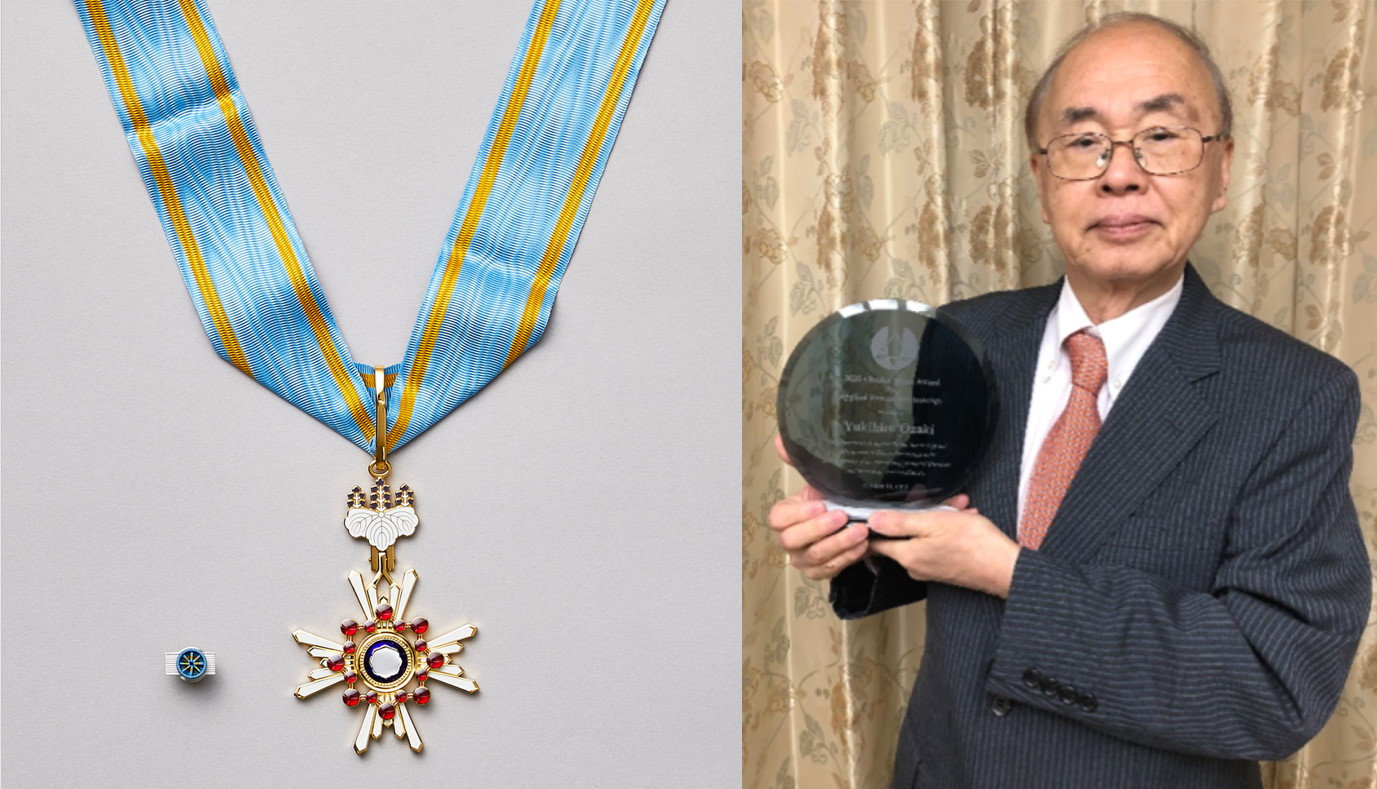
We are delighted to announce that Professor Yukihiro Ozaki will be awarded the Order of the Sacred Treasure, Middle Cordon. He is a long-standing research collaborator for us and a leading authority of spectroscopy in Japan.
This Order of Culture is awarded to persons who have made particularly outstanding achievements in public service or in other areas of scientific or cultural development over a long period of time.
It is a great honour and we have just invited Dr. Ozaki to be a speaker at a webinar organised by our Aquaphotomics International Society in April! A recording of his presentation is available on our website, so please don’t miss it!
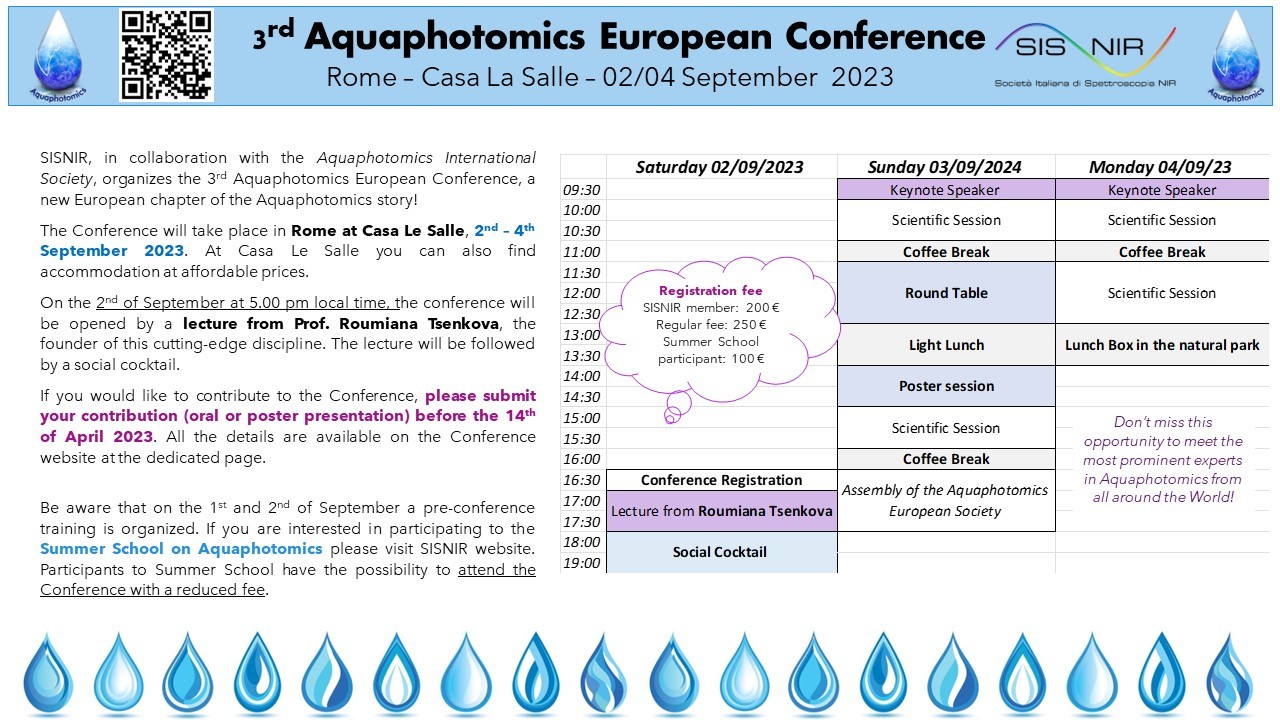
The deadline for abstract submission for the next Third Aquaphotomics European Conference (Rome, 2nd – 4th September 2023) has been extended to April 30th. Attendees can submit their contribution to the Conference as oral or poster presentation following the instructions reported on the conference website at this link: https://www.3aec.sisnir.org/index.php/abstract-submission
The Third Aquaphotomics Conference will be a unique opportunity to exchange new ideas and applications on Aquaphotomics and to meet the leading experts about this discipline.
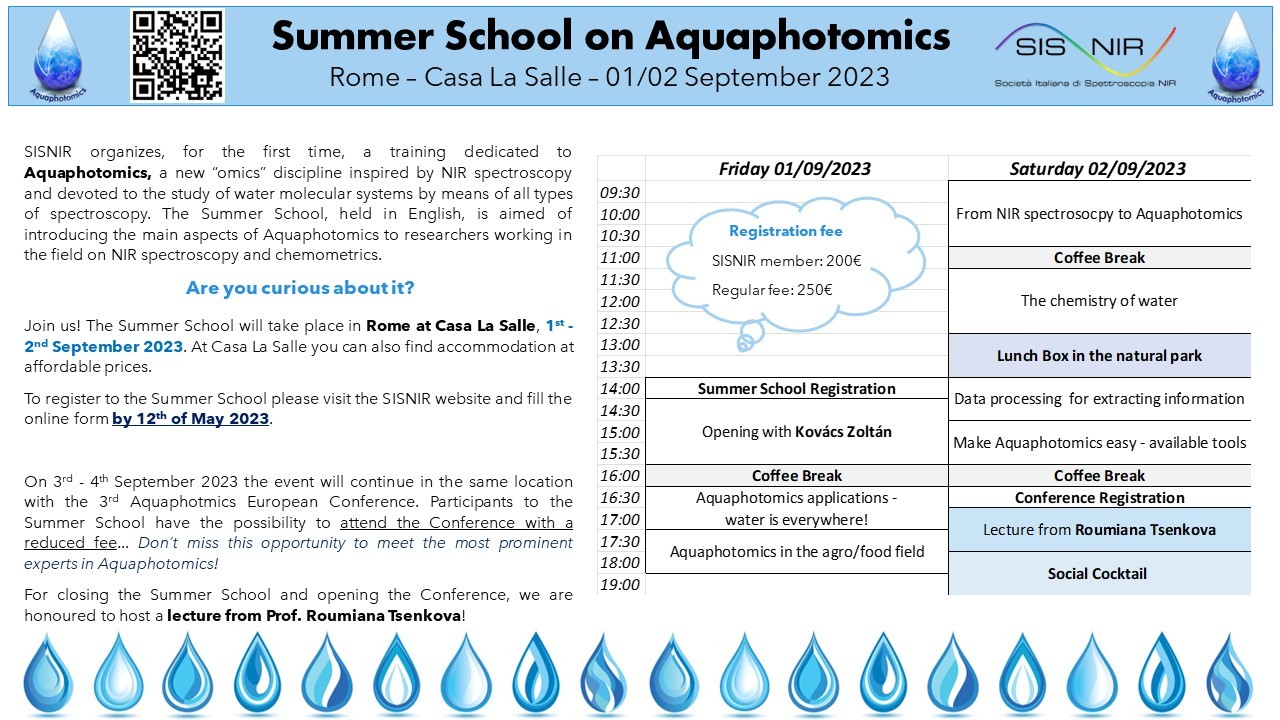
Furthermore, a Summer School on Aquaphotomis will be held in the same location before the conference, from September 1st to September 2nd 2023. The Summer School on Aquaphotomics is a dedicated training aimed at introducing the main aspects of this “omics” discipline to researchers working in the field on NIR spectroscopy and chemometrics.
Be aware that participants to Summer School have the possibility to attend the Conference with a reduced fee!
For more information about the Summer School please visit the website: https://www.sisnir.org/summer-school-2023
We are delighted to announce that our upcoming webinar will feature the distinguished Professor Emeritus, Dr. Yukihiro Ozaki. As one of the world’s foremost leaders in molecular spectroscopy, physical chemistry, and analytical chemistry research, Prof. Ozaki has made significant contributions to scientific and technological advancements throughout his illustrious career. His expertise encompasses a wide range of spectroscopic techniques, including Infrared, Raman, Near-infrared (NIR), Far ultraviolet (FUV), and terahertz spectroscopy. Prof. Ozaki has also been active in applying quantum chemistry to molecular spectroscopy, forging a strong bridge between these fields.
Prof. Ozaki has written more than 45 book chapters, 17 books, given more than 120 invited lectures all around the world and published over 1100 papers. He has been the embodiment of the motto of his research group, “top among the top” publishing an amazing 30 papers per year from 1999 to 2017! He has received 13 international and 8 Japanese awards, including the prestigious Medal with Purple Ribbon, given to those who have made significant discoveries and inventions in the field of science and technology.
But all these accomplishments aside, the human qualities of Prof. Ozaki are what make him truly grand. The things that you can not read in his papers or find on Google. For example, that he organized building of a kindergarten and care center for the kids of his researchers. Or that he raised new generations of spectroscopy leaders; many of his former students are now leaders in their fields across Japan and the world. That if you write an email to him, you will probably have an answer within 1 minute! These “little things” that do not end up on front pages or in statistics are what truly make a person remarkable and a leader. Because he inspires us to follow his example!
His unwavering mission has always been to promote the science and application of molecular spectroscopy throughout the world. During one interview given at the time he received Charles Mann Award, Professor Ozaki eloquently summarized his most significant contributions as follows: 1) pioneering the study of disease mechanisms through Raman spectroscopy, 2) establishing the application of near-infrared (NIR) spectroscopy to physical chemistry, and 3) proposing the use of attenuated total reflection-far ultraviolet (ATR-FUV) spectroscopy.
We are honored and privileged to have him as a friend and a great supporter, and we invite you to join us for this special opportunity to learn from one of the best scientists and leaders. For this webinar, Prof. Ozaki will talk to us about his latest research results in the field of NIR imaging.
The webinar will be held on April 11th on the Zoom platform, and registration is free for all who wish to attend.
We are looking forward to seeing you there!
Aquaphotomics Spring Webinar – Top Among the Top – Schedule
Time & Date: 2023/04/11 (Tuesday)
Starts at: Japan Time (JST) 5:00 PM / Central European Summer Time (CEST) 10:00 AM / Eastern Daylight Time (EDT) 4:00 AM
Ends at: Japan Time (JST) 6:00 PM / Central European Summer Time (CEST) 11:00 AM / Eastern Daylight Time (EDT) 5:00 AM
Aquaphotomics: A Novel Technique for Evaluating Lettuce Quality During Storage
Lettuces are approximately 95% water. As dietary staples, high-demand produce items like lettuce present unique challenges to the food supply chain. Consumers want fresh, juicy, crisp lettuce, but the shelf life of such a high-water content food is extremely limited by the mechanics of water molecular structure. In a world where food scarcity, resource conservation, and reduction of food waste are increasingly of concern, there is great need to better understand this process.
Researchers from the Department of Measurements and Process Control at the Hungarian University of Agriculture and Life Sciences in Budapest, Hungary and the Aquaphotomics Research Department at Kobe University in Kobe, Japan partnered to develop a rapid, non-destructive way to assess the changes of lettuce during cold storage and explain them by using aquaphotomics while monitoring the structure of water molecules in the leaves.
The scientists purchased 10 undamaged heads of lettuce, unpackaged them, and stored them in a dark fridge without washing or treatment. The refrigerator was maintained at 0-2 degrees Celsius with a relative humidity of 91-95%. Five of the lettuces were used for spectral analysis, and five were used to take reference measurements for weight, water activity, and pigment. The lettuces were monitored for 6 days in correspondence with the typical grocery store shelf life.
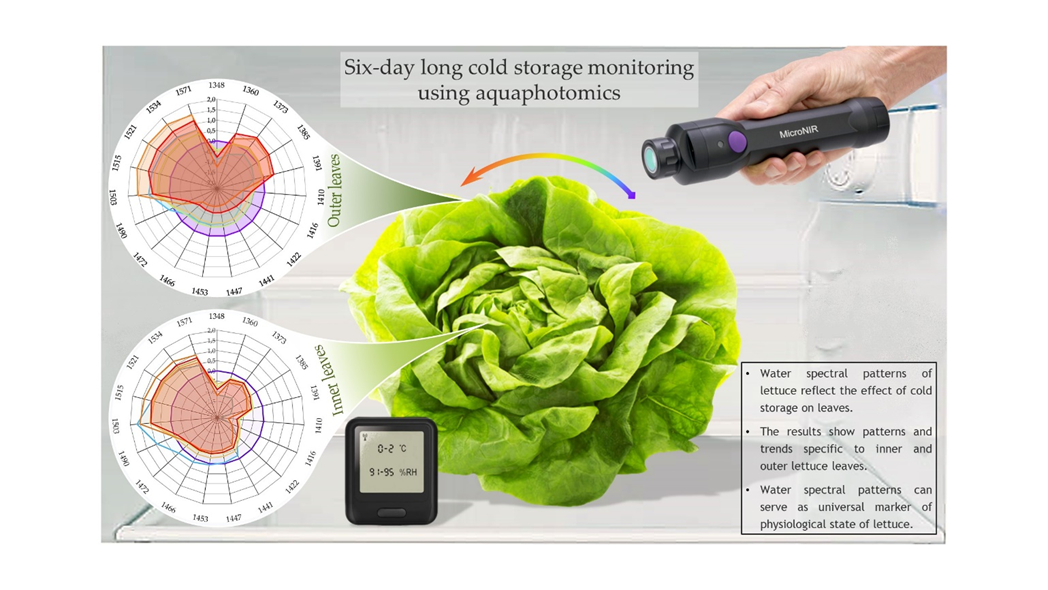
Spectra were measured in the first overtone of water, 1300-1600 nm. From the 900 spectra collected, difference spectra were made by subtracting the spectra collected on the first day of storage from the spectra collected on each consecutive day. Then, in order to analyze and visualize the measured absorbance values, the difference spectra were used to identify water matrix coordinates (WAMACs), develop aquagrams, and finally display water spectral patterns (WASPs).
By observing changes in the WASPs of the leaves, the scientists determined cold storage contributed to moisture loss, damage to cell walls, expulsion of intracellular water, loss of free and weakly hydrogen-bonded water, and stimulation of defense mechanisms. These changes were observed as changes in pigments, weight, water activity, and spectral absorbance at bands related to specific molecular structures and respective functionalities. In each measure, there was clear differentiation between the inner and outer leaves of the lettuce heads.
The changes in pigments were evaluated at three absorbance peaks (454, 479, and 678 nm) which correspond respectively to β‐carotene, chlorophyll b, and combined absorption of carotenoids and chlorophylls. For the 454 nm band, the mean absorbance significantly decreased between the first and last days of storage. For the 479 and 678 nm bands, the mean absorbance significantly increased between the first and last days of storage.
Changes in weight were measured directly and attributed to respiration, transpiration, natural deterioration of lettuces, and microbial activity. The average weight was highest on the first day, with small changes on days 2, 4, and 5, and a significant drop on day 3.
Water activity is one of the most important measures of food stability, because it provides information about the amount of water available to participate in chemical reactions. The water activity of lettuce appears to follow the same trend as the weight changes. The average water activity values reached a minimum on the fourth storage day, followed by a gradual increase.
The changes in each of these traits were observed directly in the difference spectra absorbance values. For both the inner and outer leaves, the difference spectra increased to maximum absorbance levels in the ranges 1350-1400 nm and 1500-1600 nm and decreased in the range 1400-1500 nm. These changes correspond to weakly hydrogen-bonded water, strongly bound water molecules, interactions of water and sugar and water and cellulose, and crystalline water molecules. However, the changes in absorbance values indicate that the outer leaves showed impacts of cold storage almost immediately, but the impact of the inner leaves was delayed by protection from the outer leaves. In addition, a linear relationship was observed between absorbance values and storage time which would allow storage time to be predicted using measured spectra.
Figure 1. Aquagrams of lettuce leaves calculated for each day of storage for (a) inner leaves (N = 6), and (b) outer lettuce leaves (N = 6). [1]
The results of this study show that aquaphotomics can be used to monitor changes in lettuce during storage without destroying the product. The study identified specific water absorbance bands which can be used as WAMACs for use in standard application of this method, defined a novel biomarker based on a WASP to describe the water molecular structure in lettuce leaves, and characterize changes in inner and outer lettuce leaves while in cold storage. Such aquaphotomics analysis can be used to develop a deeper understanding of the mechanisms of freshness and subsequently, to improve and innovate food preservation.
Reference
[1] Vitalis, F., Muncan, J., Anantawittayanon, S., Kovacs, Z., & Tsenkova, R. (2023). Aquaphotomics Monitoring of Lettuce Freshness during Cold Storage. Foods, 12(2), 258.
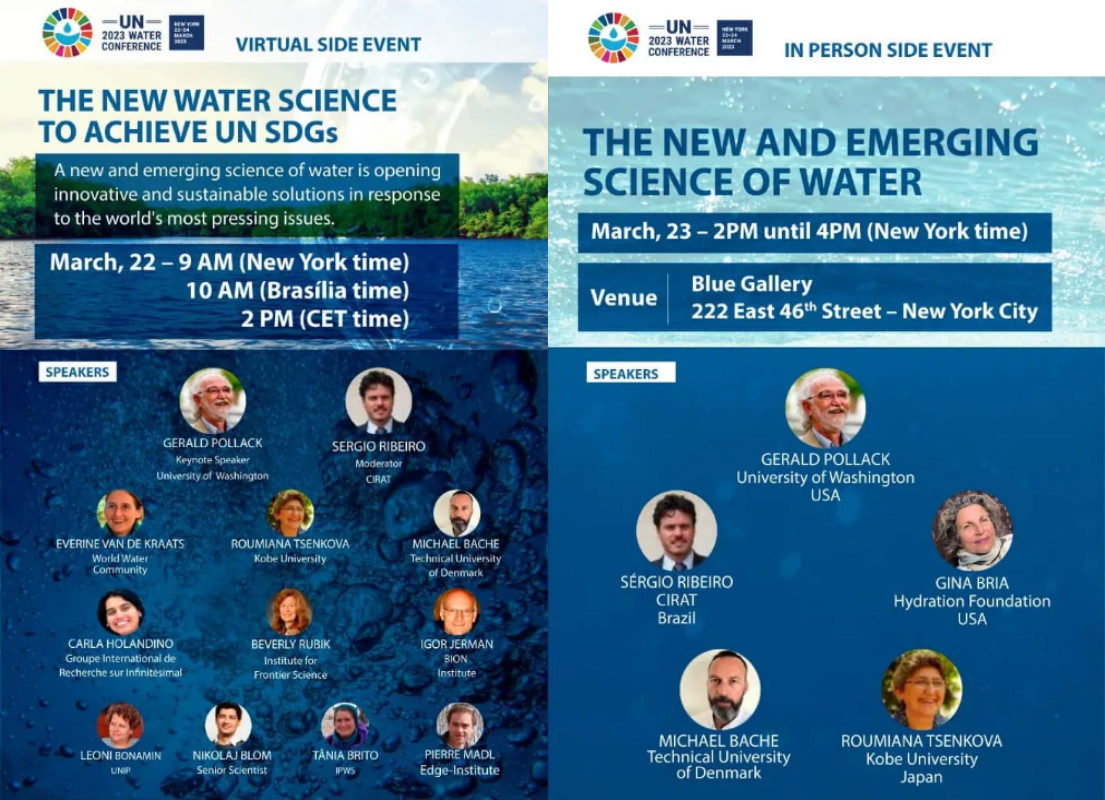
We’re delighted to announce that “New York Water Week” has officially begun as part of the UN Water Conference. In light of this event, we would like to extend an invitation to you to join us for two upcoming events that will center on the new and emerging science of water.
The first event, “The New Science of Water: Research on Physicochemical and Nano-Structural Properties of Water and Its Multiple Applications” will be held virtually on March 22. This event will feature esteemed speakers who will share their insights on the latest research in water science and its applications.
The second event, titled “The New and Emerging Science of Water: International and Cross-Sector Cooperation,” will be held in-person on March 23. It will bring together experts from various sectors to discuss ways in which international cooperation can address the water crisis.
We are honoured to have Prof. Dr. Roumiana Tsenkova, President of the Aquaphotomics International Society, as a keynote speaker for both events. She will be speaking on the topic of “Aquaphotomics: Water – Light Interaction as an Immense Source of Information on System Level.”
You can register for the events at the following two links:
We believe that these events will provide invaluable opportunities to learn and engage with others in the field. Please feel free to disseminate this information among your friends, followers, and collaborators. Thank you for your attention, and we look forward to seeing you at these events.
We are excited to announce our upcoming “something novel, something different” themed webinar with Dr. Daniel Fels, a renowned researcher in host-parasite interactions and electromagnetic cell communication. Dr. Fels is not only a world-renowned expert in his field, but he is also an engaging and captivating speaker.
Dr. Fels received his PhD from the Zoological Institut at the University of Basel in Switzerland, where he conducted research on the manipulation hypothesis in Daphnia and gut-parasites. He later went on to investigate the transmission ecology of Paramecia and micronucleus-parasites as a post-doc at the CNRS and the University Pierre et Marie Curie in Paris, France.
From 2006 to 2015, Dr. Fels pursued independent research on electromagnetic cell communication among Paramecia at the Swiss Tropical Institute in Basel and the Institute of Plant Physiology at the University of Basel. His contributions to this field have been widely recognized, and he co-edited the eBook “Fields of the Cell” in 2015.
Join us as we delve into the groundbreaking research of Dr. Fels on intercellular communication through photons. Discover how cells can communicate with each other even when separated by a glass barrier, and how this affects cell division and energy uptake. Don’t miss out on this exciting journey into the fascinating world of cellular communication!
Please mark your calendars for the webinar on March 14th. The webinar will be held, as usual, on the Zoom platform and is free for all who wish to attend. To register, please use the “Sign up” form provided below.
~ Webinar Schedule ~
Time & Date: 2023/03/14 (Tuesday)
Starts at: Japan Time (JST) 5:00 PM
Central European Time (CET) 9:00 AM
Ends at: Japan Time (JST) 6:00 PM
Central European Time (CET) 10:00 AM
To learn more Dr. Fels’ research, check out this ebook and his previous presentation below.
The Italian Society of NIR Spectroscopy – SISNIR in collaboration with the Aquaphotomics International Society organises a Summer School on Aquaphotomics, a new “omics” discipline inspired by NIR spectroscopy and devoted to the study of water molecular systems by means of all types of spectroscopies. The Summer School, that will take place in Rome from September 1st to September 2nd 2023, is aimed of introducing the main aspects of Aquaphotomics to researchers working in the field of NIR spectroscopy and chemometrics.
For further information about the Summer School on Aquaphotomics, please visit https://www.sisnir.org/summer-school-2023.
Furthermore, on September 3rd-4th 2023 the event will continue in the same location with the 3rd Aquaphotomics European Conference, a great opportunity to share ideas and applications about this cutting-edge discipline as well as to discuss with the leading experts in Aquaphotomics. Participants to the Summer School have the possibility to attend the conference with a reduced fee.