投稿者: admin

  • アクアフォトミクスを用いた浄水システムの浄化段階のモニタリング

    アクアフォトミクスを用いた浄水システムの浄化段階のモニタリング

    ※本ページは2020年に発表された論文「Aquaphotomics approach for monitoring different steps of purification process in water treatment systems」の日本語要約です。翻訳は岩井理路によるものです。

    1.要約

    現在、水質評価は物理化学的、微生物学的な指標の測定に基づいているがこれらは複数の試験を必要とし、高価で時間がかかる。アクアフォトミクスによる水質のモニタリングは水のスペクトルがあらゆる化学的・物理的摂動に敏感であり、水の状態を映し出すということを利用している。

    本研究では市販の家庭用水処理システム(浄水器)を用いて様々なろ過処理段階の水をサンプルとし、それらの近赤外スペクトルにアクアフォトミクスの手法を適用した。この手法の有効性は差スペクトル、多変量分類分析、そして水スペクトルパターンをアクアグラムによって視覚化することで示された。解析結果は一貫して、異なるろ過処理を行ったサンプルがそれぞれの特有のスペクトルパターンをもつことを示している。そしてこれらのパターンは水分子ネットワークの状態を特徴付け、それぞれの水処理の識別、処理ごとの浄化効率の追跡、浄水システムの性能モニタリングなどに利用可能である。

    2.研究方法

    サンプル

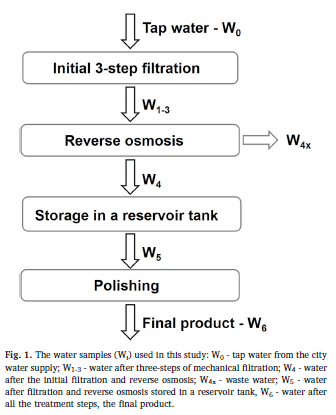
    本研究で使用する水サンプルは市販の浄水器(Proline Plus t-stage RO system, ESP Water Products, Carollton, TX)をもちいて精製された。図1に模式的に水処理のそれぞれの段階を示す(より詳細な図解は製造者のウェブサイト [22] で確認可能)。浄水器の水処理システムにおいては、水道水(W0)をまず三段階でろ過する(W1~W3)。ここでは、ポリプロピレン製のフィルターで5µm以下のチリやサビなどの浮遊物をこしとり、次に2枚のカーボンフィルターが有機物と塩素を吸着する。これら3枚のフィルターを通った水は逆浸透膜ろ過をされる。不溶固形物や重金属、バクテリア、ウィルスなどの不純物が薄い合成膜フィルムによりこしとられ、W4を生成する。逆浸透のあと、余分な塩類や望ましくない物質を含んだ廃液が機械から排出される(W4x)。浄化された水(W4)はタンクに貯蔵される(W5)。そしてココナッツ殻を用いて水に溶け込んだ気体や臭いが取り除かれる磨き上げの最終工程を経て飲用水(W6)が精製される。

    図1 本研究の水サンプル: W0-水道水, W1~3-3段階ろ過後の水, W4-逆浸透ろ過後の水, W4x-廃液, W5-タンク内の貯蔵水, W6-全水処理段階をへた最終精製水

    近赤外分光法

    水サンプルのスペクトル測定は、光路長1mm、波長範囲900nmから1700nmまで、8nmステップ、透過光モードで実施した。1つのサンプルにつき10回連続で取得した(各連続スペクトルは10の同時加算スペクトルの平均)。実験は、3日間で3回繰り返し、水サンプルは7種類(W0,W1~3, W4,W4x,W5,W6)、都度新たに調製したサンプルを使用した。合計210本のスペクトルを取得した。

    データ解析

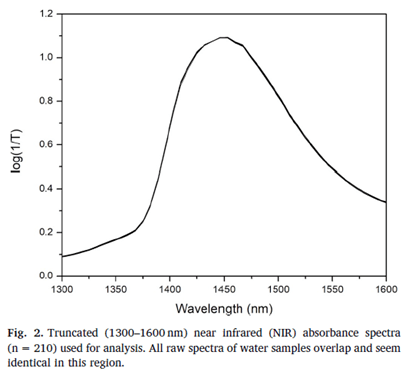
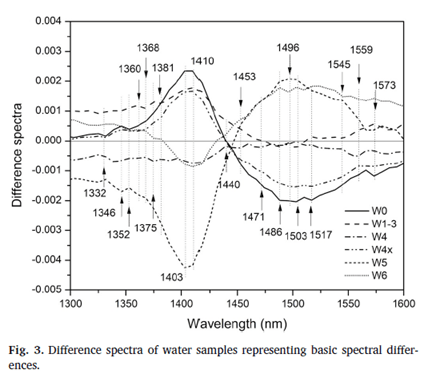
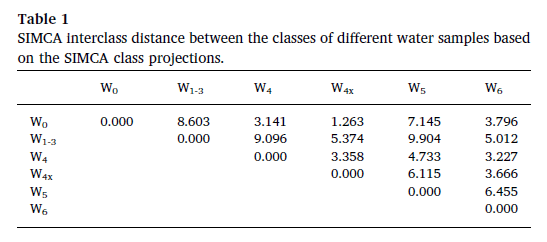
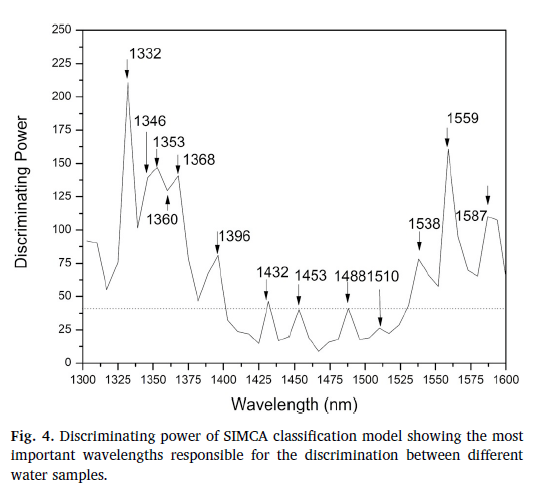
    水のOH伸縮振動の第1倍音を解析するためにスペクトルは1300nmから1600nmまでの波長範囲を使用した。異なるサンプル間のスペクトルの違いを調査するために差スペクトルを計算し、主成分分析とSIMCA法による判別分析を適用した。

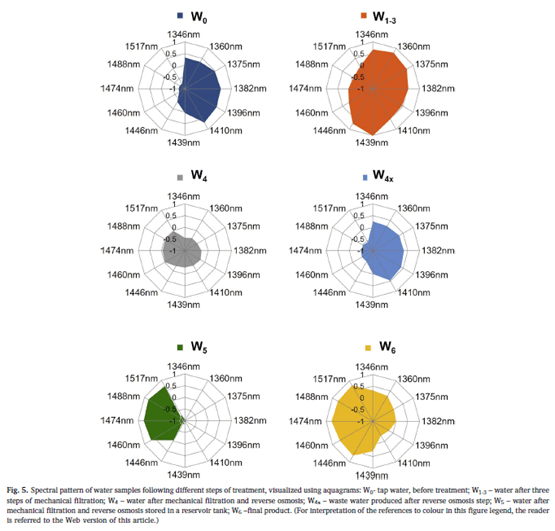
    ろ過処理過程での、水構造変化の詳細な特徴を調べるため、特定の水による吸収バンド(波長範囲6~12nm)のパターンを分析した。これらのバンドはWAMACS(水マトリックス座標)と呼ばれる。先行研究(Tsenkova et al.)において、さまざまな水分子種をカバーする12の特徴的な水波長範囲が定義されており、水の第一倍音領域の特徴的なスペクトルパターンを表すのに役立っている[7]。WAMACSの変動は水のスペクトルパターン(WASP)を表し、アクアグラムによって視覚化することができる[26]。レーダーチャート(アクアグラム)は異なる水分子構造に関係した12のWAMACSにおける正規化吸光度をサンプルごとに表示する。

    3.結論

    本研究により、様々なろ過処理段階の水をモニタリングすることへのアクアフォトミクスがもつ有効性が示された。アクアフォトミクスの手法を用いた水の近赤外スペクトル解析は微細でありながら検出可能で一貫性のある差異を示した。このスペクトルの差異は異なる種類のろ過処理を経たことによる水分子ネットワーク構造の変化に関係している。水分子ネットワークに対する物理化学的・微生物学的指標それぞれの変化が積み重なって与える影響を表す特徴付けに水のスペクトルパターンをもちいることができる。

    アクアフォトミクス近赤外分光法に基づくリアルタイムのオンラインシステムは、水の構造変化の検出に基づいて水質の変化を通知することで、浄化処理中および使用時の水質を監視するための効率的で実用的なアプローチを提示できる可能性がある。

    図2 解析に使用された1300nmから1600nmまでの近赤外(NIR)スペクトル(n=210)。
    図3 基本的なスペクトルの違いを表すサンプルの差スペクトル。
    表1 SIMCAの種別推定に基づくろ過処理過程の近縁度。
    図4 SIMCA分類モデルの識別力。ろ過処理過程の識別に重要な波長を示す。
    図5 アクアグラム表示によるろ過処理過程でのスペクトルパターン。
    W0:ろ過前の水道水 W1-W3:3段階ろ過の生成水 W4:逆浸透膜ろ過の生成水
    W4x:逆浸透膜ろ過の廃液 W5:貯蔵水 W6:磨き上げ後の最終生成水

    参考文献

     [7] R. Tsenkova, Aquaphotomics: dynamic spectroscopy of aqueous and biological

    systems describes peculiarities of water, J. Near Infrared Spectrosc. 17 (2009)

    303–313, https://doi.org/10.1255/jnirs.869.

    [22] EPS Water Products, Proline Plus five stage RO system, https://www.

    espwaterproducts.com/proline-plus-five-stage-ro-system/, (2019) , Accessed date: 1

    September 2019.

    [26] R. Tsenkova, Aquaphotomics: water in the biological and aqueous world scrutinized with invisible light, Spectrosc. Eur. 22 (2010) 6–10.

  • Carrie K. Vance

    Group leader : Carrie K. Vance

    Affiliation: Mississippi State University, Department of Biochemistry, Molecular Biology, Entomology, and Plant Pathology, Mississippi State, MS, USA 39762

    Research Topics : Animal physiology, Amphibian conservation, NIR and NMR spectroscopy applied to animal and plant pathogens and diseases.

    Contact: [email protected]

    Description: Our research group started working with spectroscopic applications in animal physiology when Dr. Vance joined a research team focusing on NIR analysis of nutrition in the Giant Panda. We expanded our studies to develop NIR spectroscopic methodologies for determining basic physiological parameters (e.g. gender, reproductive status, age, disease) with the end goal of mapping the demographic movements of giant panda in-situ. Additionally, we have applied NIR spectroscopy to numerous other mammalian species (horses, cattle, elephants, okapi, leopards) and extended our research into non-mammalian taxa (anura, caudates, fish).

    Aquaphotomics work: We have used Aquaphotomics to profile the reproductive status of Snow leopards and Amur leopards using NIR spectra collected from urine. In addition, we evaluated the reproductive cycling and performance of mares exposed to the fusarium mycotoxin Zearalenone, which causes hyperestogenism, by the analysis of blood serum spectra. Currently, we are using NIR spectroscopy and Aquaphotomics to analyze biochemical profiles of the pathogens Bovine Herpesvirus type 1, Bovine Respiratory Syncytial Virus, Mannhemia haemolytica, Xanthomonas spp, and Rhizoctonia solani. Our ultimate goal is to understand the biochemical changes occurring during the course of disease, and validate spectra profiling early stages of infection. Deterministic spectra feed into the development of NIR spectroscopy as a rapid, portable, non-destructive, and accurate diagnostic tool capable of reducing the time required for pathogen and disease detection and identification, which is a determining factor in infection-related mortality rates and the control of further disease spread.

  • Chemoinformatics@Nankai University

    Group Leader: Prof. Xueguang Shao

    Affiliation: College of Chemistry, Nankai University, China

    Research Topics: Chemometrics, Near–infrared spectroscopy, Analytical Chemistry

    Contact email: [email protected]


    Description

    A series of chemometric methods were developed for analyzing complex systems, including chemical factor analysis (CFA), optimization methods, wavelet transform (WT), and immune algorithm (IA). Particular attention was paid to the studies of near infrared spectroscopy. Chemometric methods for near–infrared (NIR) spectral analysis, including the methods for spectral pre-processing, outlier detection, variable selection, and the methods for quantitative and discrimination analysis. Works for the micro-analysis by NIR spectroscopy were conducted as well based on the combination of chemometric and experimental strategies. The research interests of the laboratory also include the application of NIR spectroscopy in the monitoring of industrial productions and the quality control of drugs and natural products.

    In recent works, research works are concentrated on temperature–dependent NIR spectroscopy. Quantitative models between NIR spectra and temperature was studied and applied to the quantitative determination of the compositions in mixtures and the analytes in aqueous solutions, as well as the structural analysis in the transformation of proteins and polymers. In these works, water was taken as a probe for sensing the quantity and the structure of the analytes. Therefore, chemometric methods for extracting the information from NIR spectrum of water was developed. In the future works, application of temperature–dependent NIR spectra in analyzing bio-systems will be concentrated on, e.g., disease diagnosis based on the spectra of bio-liquids.

    Aquaphotomics Related Work

    Similar with the studies of aquaphotomics, the spectrum of water was taken as the main source of the information. Water serves as a mirror to reflect the quantity, structure and the interactions in the analyzing systems. Therefore, methods for deeply mining the fine spectral features of water and their variation with temperature are needed. Up to now, water structures in different solutions were studied by temperature–dependent NIR spectroscopy, and the complexity of water structures was studied by molecular simulations. Chemometric methods for enhancing the resolution of the NIR spectrum and retrieving the spectral information for different water species were developed. Furthermore, quantitative determination and understanding of the structural changes of proteins and polymers by the change of the spectral features of water with temperature was conducted. Water was proven to be a good probe for indicating the quantity and the structure of the analytes in aqueous and bio-liquid systems.

  • SpectroscopyLab

    Group Leader: Dr. Ahmad Fairuz Omar

    Affiliation: School of Physics, Universiti Sains Malaysia, Malaysia

    Research Topics: Environment, Food Quality, Plant Disease, Cancer Detection, Dermatology

    Website or contact email: http://www.fizik.usm.my/index.php/about-us/our-people/academic/senior-lecturer/27-staff/senior-lecturers/63-ahmad-fairuz-bin-omar


    Description

    Dr. Ahmad Fairuz Omar currently leading an optical spectroscopy research group in the School of Physics, Universiti Sains Malaysia (USM). He completed his master’s degree in 2009 with research on the development of an optical fiber sensor in the measurement of water turbidity. He then completed his Ph.D. in 2012 with a research topic on the application of visible and near-infrared spectroscopy in measuring intrinsic qualities of B10 Averrhoa carambola. For the last 10 years, he has been working to fully utilize the application of optical spectroscopy, especially for environmental monitoring, food quality analysis, and medical diagnosis. He is actively reaching out for collaboration with various research faculties in Malaysia and neighboring countries, in enhancing the establishment of spectroscopy network and contribution within this region. In addition, Dr. Omar regularly organized outreach programs to high school and general public in promoting awareness on issues related to sustainability and quality of life, and the potential role that optical spectroscopy carries in handling quality issues from instrumentation and measurement point of view.

    Aquaphotomics work

    Dr. Omar has previously published several articles on the application of near-infrared spectroscopy in the measurement of aqueous sugars and acids concentration and also in food quality analysis. His current research focus is on implementing near-infrared spectroscopy and aquaphotomics in cancer diagnosis and in skin quality measurement, especially those related to moisture measurement of stratum corneum layer on human skin. This research is in collaboration with the Malaysian Institute of Pharmaceuticals and Nutraceuticals (IPharm) and Advanced Medical and Dental Institute (AMDI), USM.

    Dr. Omar can be contacted at [email protected] and his full academic and research background can be assessed at:
    http://www.fizik.usm.my/index.php/about-us/our-people/academic/senior-lecturer/27-staff/senior-lecturers/63-ahmad-fairuz-bin-omar

  • アクアフォトミクス ― 革新的知識から科学と技術の統合プラットフォームへ

    アクアフォトミクス ― 革新的知識から科学と技術の統合プラットフォームへ

    「Molecules」誌の「Special Issue: Advances in Near Infrared Spectroscopy and Related Computational Methods」において、アクアフォトミクスに関する新しいレビュー論文が掲載されたことを、大変うれしくお知らせいたします。

    “Aquaphotomics—From Innovative Knowledge to Integrative Platform in Science and Technology” by Jelena Muncan and Roumiana Tsenkova (Published: 28 July 2019)

    Aquaphotomics is a young scientific discipline based on innovative knowledge of water molecular network, which as an intrinsic part of every aqueous system is being shaped by all of its components and the properties of the environment. With a high capacity for hydrogen bonding, water molecules are extremely sensitive to any changes the system undergoes. In highly aqueous systems—especially biological—water is the most abundant molecule. Minute changes in system elements or surroundings affect multitude of water molecules, causing rearrangements of water molecular network. Using light of various frequencies as a probe, the specifics of water structure can be extracted from the water spectrum, indirectly providing information about all the internal and external elements influencing the system. The water spectral pattern hence becomes an integrative descriptor of the system state. Aquaphotomics and the new knowledge of water originated from the field of near infrared spectroscopy. This technique resulted in significant findings about water structure-function relationships in various systems contributing to a better understanding of basic life phenomena. From this foundation, aquaphotomics started integration with other disciplines into systematized science from which a variety of applications ensued. This review will present the basics of this emerging science and its technological potential.

    オープンアクセス論文は、以下のリンクから閲覧およびダウンロードできます:
    https://www.mdpi.com/1420-3049/24/15/2742


    Recent News

    • Precision Horticulture

      Group Leader: Prof. Manuela Zude

      Affiliation: Leibniz Institute for Agricultural Engineering and Bioeconomy (ATB), Germany

      Research Topics: fruit quality; irrigation; oxygen shortage; spatially resolved spectroscopy, frequency based spectroscopy


      Description

      The group Prec_Hort works on research questions related to precise production measures in fruit growing. The group is active in the development of optical sensors and turning the signals into plant information. The plant information obtained is used in the agronomic processes. The Prec_Hort work group is located in the Leibniz Institute for Agricultural Engineering and Biotechnology (ATB), Potsdam, Germany. Here we have an optical laboratory and an experimental station providing some two thousand apple trees with two cultivars in random design and sweet cherry trees capturing >70 varieties to run experiments. We are a group of five researchers in various steps of our careers supported by excellent engineers.

      Aquaphotomics work

      Our research questions target the following three steps to integrate sensors in the precise fruit production:

      • Characterisation of physical properties of fresh fruit
      • The in-situ assessment of fruit by means of spectral-optical (multi- and hyper-spectral methods in the visible and near infrared wavelength range, time-resolved laser-induced fluorescence spectroscopy, spatially resolved spectroscopy [backscattering imaging]) and whole trees by means of light detection and ranging laser scanners.
      • Applications of Precision Horticulture such as zone-specific harvest management and more precise irrigation management considering soil zones, plant growth (leaf area) and fruit developmental stage

      Any exchange within Aquaphotomics on the optical sensing and its application would be very interesting to us.

      Contact: https://twitter.com/prec_hort?lang=en

    • 「Water Channeling Life」:慶應義塾大学医学部とサントリーグローバルイノベーションセンター株式会社による共同研究プロジェクト

      慶應義塾大学医学部 と サントリーグローバルイノベーションセンター株式会社

      アクアフォトミクスは、非侵襲的な近赤外分光法を用いた水の包括的解析です。溶液や身体を近赤外線でスキャンすることで、水分子のダイナミクスを明らかにする情報を得ることができます。私たちは、ミネラルウォーター、尿、皮膚に関する研究を通じて、水のダイナミクスと健康の関係を理解することを目指しています。

      アクアフォトミクスは、このプロジェクトの共同研究者である神戸大学のツェンコヴァ教授によって開発されました。

      リンク:http://www.water-channeling-life.com/en/themes/02.html

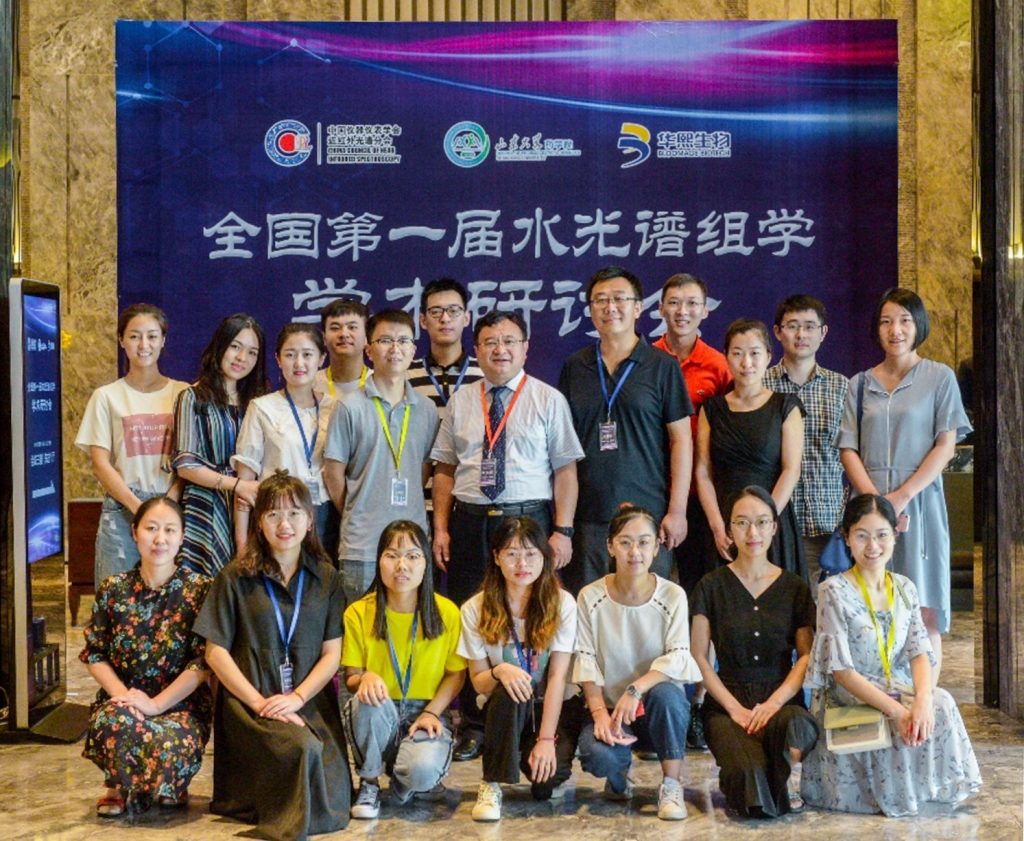
    • 第2回アクアフォトミクス国際シンポジウム2016年11月26日~29日、神戸(日本)

      第2回アクアフォトミクス国際シンポジウム2016年11月26日~29日、神戸(日本)

      第2回アクアフォトミクス国際シンポジウムは、2016年11月26日から29日にかけて日本の神戸大学で開催されました。
      この会議には、あらゆる大陸の10か国以上から、異なる分野に属する70名を超える研究者が参加しました。
      会議は、現在アクアフォトミクス科学が触発している多様なプロジェクトや出版物を反映するものとなりました。

    • The Austrian-Hungarian research group for NIRS and Aquaphotomics applications

      Research Topics: NIR spectroscopy and the related instrumentation, data evaluation techniques, software and programming

      There is a little group in the middle of Europe consisting of three young research fellows having devotion towards NIR spectroscopy and the related instrumentation, data evaluation techniques, software and programming.

      One of the fellows, Dr. Bernhard Pollner <[email protected]> from Austria, graduated to MD at Innsbruck Medical School in 2004. He has been working as an independent researcher consultant in the field of water science since his graduation. During his scientific activities Bernhard acquired a good knowledge of many different methods in this field. One of his special interests lies in complex algorithms and high-throughput computations using R, a free software environment for statistical computing and graphics. Since his three months stay in Professor Roumiana Tsenkova’s laboratory, at Kobe University, Japan, together with the other two fellows Zoltan and George, he worked on various projects in the field of NIRS and Aquaphotomics. He is currently a PhD student at University of Innsbruck, Austria.

      George Bazar, PhD <[email protected]>, one of the Hungarian fellows, started learning about NIRS as a PhD student in Professor Robert Romvari’s laboratory at Kaposvar University in 2005. Later he was mentored by Professor Karoly Kaffka who motivated him to attend the next IDRC in Chambersburg. At this meeting in 2008 George met many pioneers of NIRS, among them the famous Karl Norris considered to be the father of NIR spectroscopy, and Roumiana Tsenkova who introduced him Aquaphotomics. Thanks to this acquaintance, after defending his PhD in 2011, he successfully applied for a JSPS postdoc position at Professor Tsenkova’s laboratory, where he spent two years. Half a year after his arrival Zoltan joined the same team, and they started working together on different research topics in the field of Aquaphotomics. George returned to Hungary in 2014 and since then he has been working at Kaposvar University as Research Fellow. His valuable work has been awarded by the Postdoctoral Fellowship Grant in the frame of the New National Excellence Program of the Hungarian Government.

      The second Hungarian fellow, Zoltan Kovacs, PhD <[email protected]>, started his scientific activity in the field of instrumental taste sensing and defended his PhD diploma in 2012 in the topic of the problems with electronic tongue measurements. He gained knowledge about experimentation, uni- and multivariate data analysis related to the above mentioned topics, which gave him the opportunity to apply to Professor Tsenkova’s laboratory where he learned the basics of NIRS and Aquaphotomics techniques working together with George and later with Bernhard. Zoltan returned to Hungary in 2016 and works at his home university, Szent István University, Budapest, as assistant professor and beside his original field he makes great efforts to do research in the field of NIRS and Aquaphotomics. His work has been awarded by the Janos Bolyai Postdoctoral Research Grant given by the Hungarian Academy of Sciences.

      George and Zoltan realized the high importance of the stability of the spectrometers when the Aquaphotomics approach was applied and started to pay attention to the stabilization of the experimental arrangements, widening the knowledge of Aquaphotomics with their observations. While Bernhard and Zoltan have been working to develop dedicated software for Aquaphotomics calculations since they met in Japan.

      Bernhard, George and Zoltan continuously look for the opportunities to extend the research of NIRS and Aquaphotomics and they keep working on research projects with Professor Tsenkova at Kobe University, but they are willing to build collaborations with other groups, too.

      Beside the academic presence they have founded a consulting company in Hungary, Correltech Bt., to provide a more flexible way of collaboration of researchers related to NIR spectroscopy and other correlative analytical technologies worldwide. They all were invited to the scientific team of Tellspec Inc., an innovative data company offering real-time food analysis with a small handheld NIR spectrometer connected with a cloud-based analysis engine.

      These research fellows aim to build a wide international scientific cooperation in NIR spectroscopy, multivariate data analysis, and in the field of possible applications. Therefore, they are ready to support cooperation with their knowledge in instrumentation, experimentation, data evaluation, software and programming.

      Contact: Zoltan Kovacs <[email protected]>

    • NIRS Laboratory

      Group leader : Professor Roumiana Tsenkova

      Affiliation: Kobe University, Japan

      Research Topics : Near Infrared Spectroscopy, Water Science, Biomeasurement, Aquaphotomics.


      NIRS Laboratory is the cradle of Aquaphotomics, a new scientific discipline, proposed by Professor Roumiana Tsenkova in 2005. The Laboratory is working on various applications and new developments in the area of near infrared spectroscopy (NIRS) as non-destructive technology for monitoring and diagnosis of biological and aqueous systems. Qualitative and quantitative analysis applied in biological- and food-related research and technology, as well as understanding new phenomena related to water in biology are the main area of interest. We proposed a new scientific area called Aquaphotomics as a new member in the “omics” area devoted to examine “all about the interaction between water and light” and present spectroscopy as an important tool to study the functionality of water in Life science.

      Websitehttp://nirslab.org/