Author: admin

  • Aquaphotomics Spring Webinar

    Aquaphotomics Spring Webinar

    Aquaphotomics Spring Webinar


    Recording is now available on the Aquaphotomics YouTube Channel!

    Thank you so much for joining us at the webinar! I hope you all enjoy Prof. Hayashi’s talk.

    As promised, here is the link to the webinar recording:

    The subtitles language can be changed to Japanese or other languages.

    • Enable “Subtitles/closed captions”, then go to Settings->Subtitles->Auto-translate->select a language.

    字幕の言語を日本語や他の言語に変更することができます。

    • 字幕をオンにして、「設定」→「字幕」→「自動翻訳」→「日本語」

    If you have any questions, please leave a comment, or email us at info@aquaphotomics.com.

    You can also find previous webinar recordings and many other videos about Aquaphotomics on our YouTube channel (https://www.youtube.com/c/Aquaphotomics), so please subscribe!

    We will have another webinar coming up in April. See you soon!


    Dear Friends and Colleagues,

    It is our pleasure to announce a new aquaphotomics webinar, first one this year, marking the beginning of a spring season, and hopefully a successful year for all of us.

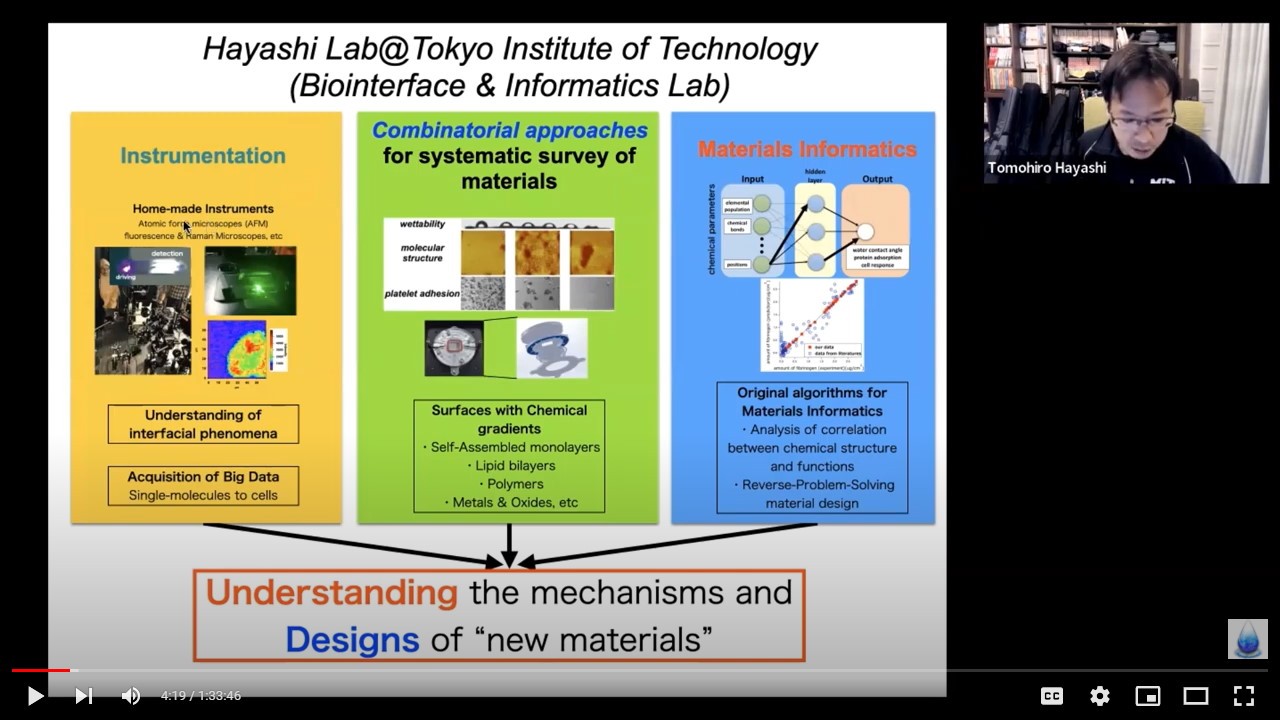
    This time, we have a pleasure to host the lecture of Prof. Tomohiro Hayashi, from Tokyo Institute of Technology, who will be talking about the role of water in the mechanism underlying bio inertness of materials.

    Prof. Hayashi is a regular attendant of the Aquaphotomics Conferences, and his lectures are always advanced and very inspiring.

    Please find short abstract of his lecture below. The webinar will be held using Zoom platform, 1h for the lecture and 30 min for discussion; free for all who wish to participate. All you need to do is to sign up for attendance using the “Sign up” form provided below.  

    The webinar will be held in English, and it will be recorded and made available on the Aquaphotomics YouTube channel shortly afterwards, with Japanese subtitle.

    We are looking forward to seeing you at the Aquaphotomics Spring Webinar!


    Aquaphotomics Spring Webinar – Schedule

    [amo_member id=”4811″ item-width=”150″ align=”right” item-margin=”0″ full-width=”no” panel=”right”]

    Speaker: Associated Professor Tomohiro Hayashi, Tokyo Institute of Technology, Japan

    Title: Mechanism underlying anti-biofouling: behavior of molecules at bio interfaces

    Abstract: Although surfaces rejecting adsorption of biomolecules and adhesion of cells and microorganisms (anti-fouling surfaces) are highly demanded, designs of these surfaces still involve difficulties because of the lack of understanding of the underlying mechanism. We first discuss the mechanism underlying the bio inertness of oligo (ethylene glycol)-, zwitterionic-, DNA, and peptide-terminated self-assembled monolayers (SAMs) by investigating the interfacial behavior of water molecules by surface force and surface-sensitive vibrational spectroscopic techniques. Our surface force measurements evaluating the interaction between SAMs in a physiological condition revealed that all investigated bioinert SAMs exhibited water-induced repulsion. In contrast, bio adhering SAMs do not show repulsion. Surface-enhanced infrared absorption spectroscopy unveiled the characteristic hydrogen bonding state of water molecules near the nonfouling monolayers. These results exhibit that interfacial water plays the role of a physical barrier to prevent bioadhesion.

    Time & Date: 2022/03/15 (Tuesday)
    Starts at: Japan Time (JST) 5:00 PM / Central European Time (CET) 9:00 AM

    Ends at: Japan Time (JST) 6:30 PM / Central European Time (CET) 10:30 AM


  • Special Issue: “Aquaphotomics – Exploring Water Molecular Systems in Nature” (Deadline extended)

    Special Issue: “Aquaphotomics – Exploring Water Molecular Systems in Nature” (Deadline extended)

    We are pleased to announce that Prof. Tsenkova and Prof. Muncan are guest editing special issue “Aquaphotomics – Exploring Water Molecular Systems in Nature” in the open access journal Molecules (ISSN 1420-3049, https://www.mdpi.com/journal/molecules).

    Special Issue: Aquaphotomics – Exploring Water Molecular Systems in Nature

    Website: https://www.mdpi.com/journal/molecules/special_issues/Water_Molecular
    Submission Deadline (extended): 30 June 2022

    Author instructions can be found here: https://www.mdpi.com/journal/molecules/instructions.

    If you are interested in contribution or have any questions, please do not hesitate to let us know or contact the Assistant Editor (olivia.zhang@mdpi.com).

    We look forward to your submissions!

  • The World First Industrial Aquaphotomics Laboratory Opened at Yunosato in Wakayama, Japan

    The World First Industrial Aquaphotomics Laboratory Opened at Yunosato in Wakayama, Japan

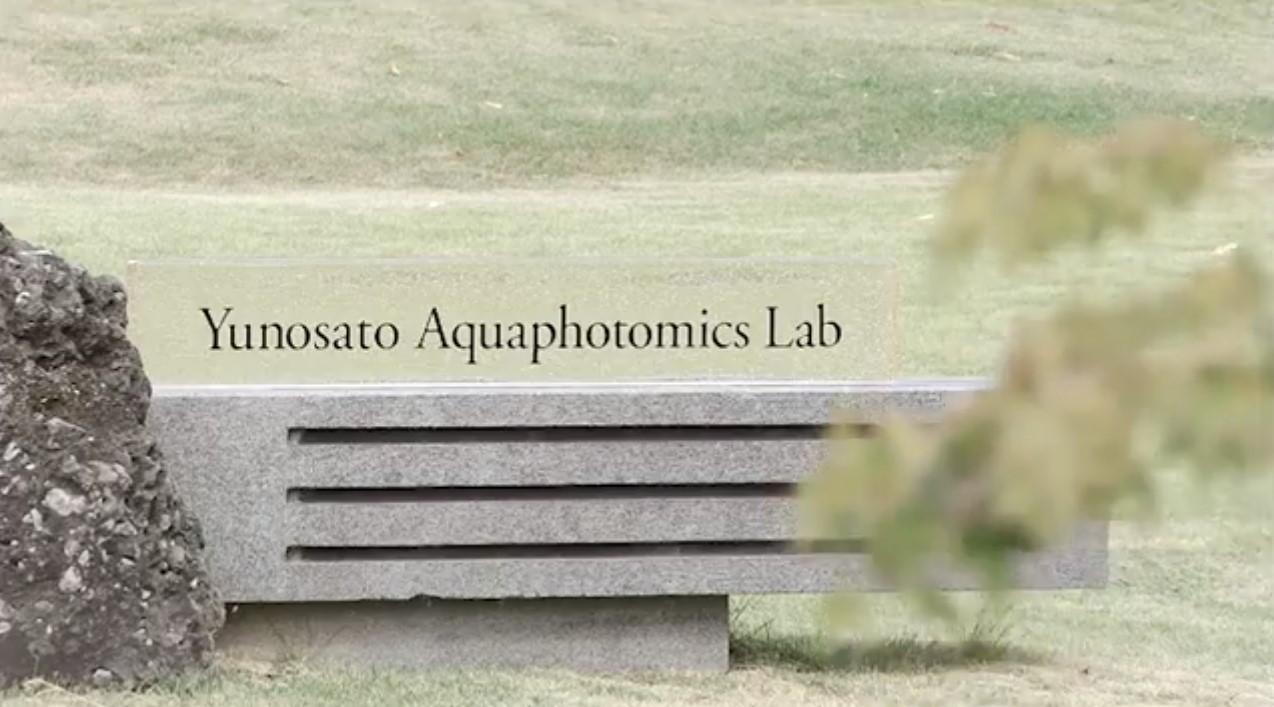
    Mr. Shogo Shiegoka, the owner of the “Yunosato Aquaphotomics Lab” located in Wakayama, had an interview with the local TV station. In the interview, he talked about how he learned about Aquaphotomics and the future plan of the Aquaphotomics Lab. Check out the video below!

    (English and Japanese subtitles available on YouTube)

  • Luc Montagnier, a Great Scientist and Our Dear Friend Passed Away

    Luc Montagnier, a Great Scientist and Our Dear Friend Passed Away

    It is with sad heart that we share this news with the Aquaphotomics community. Professor Luc Montagnier, co-discoverer of human immunodeficiency virus (HIV) and a winner of Nobel Prize in 2008, died, aged 89 on 8th February, 2022.

    Professor Montagnier is one of the scientists whose life really made a difference.  His dedication to science and his co-discovery of HIV highly influenced the research and development of antiretroviral medicines, which helped saved the lives of millions of people around the world.

    We will fondly remember his lectures at the Water Conference (on the Physics, Chemistry and Biology of Water), his visit to Kobe University, our former Biomeasurement Technology Laboratory, and our experiments together.

    We shared a love for water and love for science. And we will always be grateful for his support for Aquaphotomics and our work.

    He is a friend that will be very missed.

    Aquaphotomics community sends heartfelt condolences to his family and friends.

  • Aquaphotomics Research of Cold Stress in Soybean – Our Latest Publication in Special Issue of Molecules journal, Aquaphotomics – Exploring Water Molecular Systems in Nature

    Aquaphotomics Research of Cold Stress in Soybean – Our Latest Publication in Special Issue of Molecules journal, Aquaphotomics – Exploring Water Molecular Systems in Nature

    The development of non-destructive methods for early detection and understanding the mechanism of cold stress in plants is one of the very important aspects of crop breeding programs to which aquaphotomics research aims to contribute with new insights and solutions.

    After many years of dedicated research in this area, we are proud to report that the first step towards this goal has been achieved. Our paper “Aquaphotomics Research of Cold Stress in Soybean Cultivars with Different Stress Tolerance Ability: Early Detection of Cold Stress Response” has been published this month in the Special Issue of Molecules journal, Aquaphotomics – Exploring Water Molecular Systems in Nature.

    This paper is a product of joint efforts of our well known aquaphotomics team, Assist. Prof. Dr J. Muncan and Prof. Dr R. Tsenkova, and also pioneers of exploration of plant stress using aquaphotomics, Prof. Dr B.M.S. Jinendra and Prof. Dr S. Kuroki. Prof. Jinendra and Prof. Tsenkova authored the first aquaphotomics publication about early diagnosis of mosaic virus infection in soybean using aquaphotomics, more than 10 years ago, paving the way towards many other contributions in biotic stress diagnosis. Prof. Kuroki on the other hand, co-authored the first aquaphotomics paper which reported that the ability of the resurrection plants to survive very long periods without water are directly related to the water self-organization expressed as dynamic changes of water molecular structures in their leaves.

    The newly published paper shows that with aquaphotomics, we were able to detect the effects of even very mild cold stress in soybean plants, in a completely non-destructive manner, and further on to even observe that soybean cultivars with different stress tolerance abilities could be distinguished. This paper is only the first one in the planed series of 3 papers, all of which explore the cold stress in soybean from different aspects, but in the future publications we will show how the genotypic differences are actually related to water molecular structure of the leaves resulting in different susceptibility of soybean cultivars to cold stress.

    Stay with us and wait for more exciting discoveries in our next soybean publications.

    Until then, we hope you will enjoy our first paper in this series and the incredible simplicity of early cold stress detection.

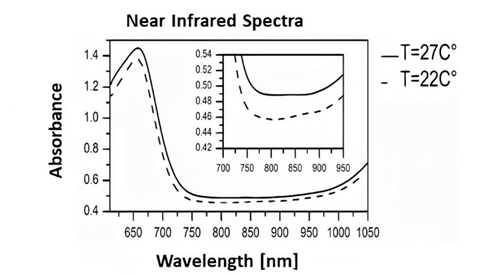
    Figure 1. Aquagrams showing differences in the average spectral pattern of all soybean cultivars in the conditions of no stress and during cold stress. (Source:  Muncan, J.; Jinendra, B.M.S.; Kuroki, S.; Tsenkova, R. Aquaphotomics Research of Cold Stress in Soybean Cultivars with Different Stress Tolerance Ability: Early Detection of Cold Stress Response. Molecules 2022, 27, 744. doi.org/10.3390/molecules27030744)

    The paper can be found at the following webpages: 

    Abstract: https://www.mdpi.com/1420-3049/27/3/744
    Full Text: https://www.mdpi.com/1420-3049/27/3/744/htm

  • Aquaphotomics Christmas Special

    Aquaphotomics Christmas Special

    Aquaphotomics Christmas Special


    Recording of Christmas Webinars are now available on the Aquaphotomics YouTube Channel!

    Thank you for joining us at the webinars!

    We are in process of planning more upcoming webinars. We will be sure to update everyone when we are ready to go. Thank you for your continued support in Aquaphotomics!

    Webinar #1

    Webinar #2


    Dear Friends and Colleagues,

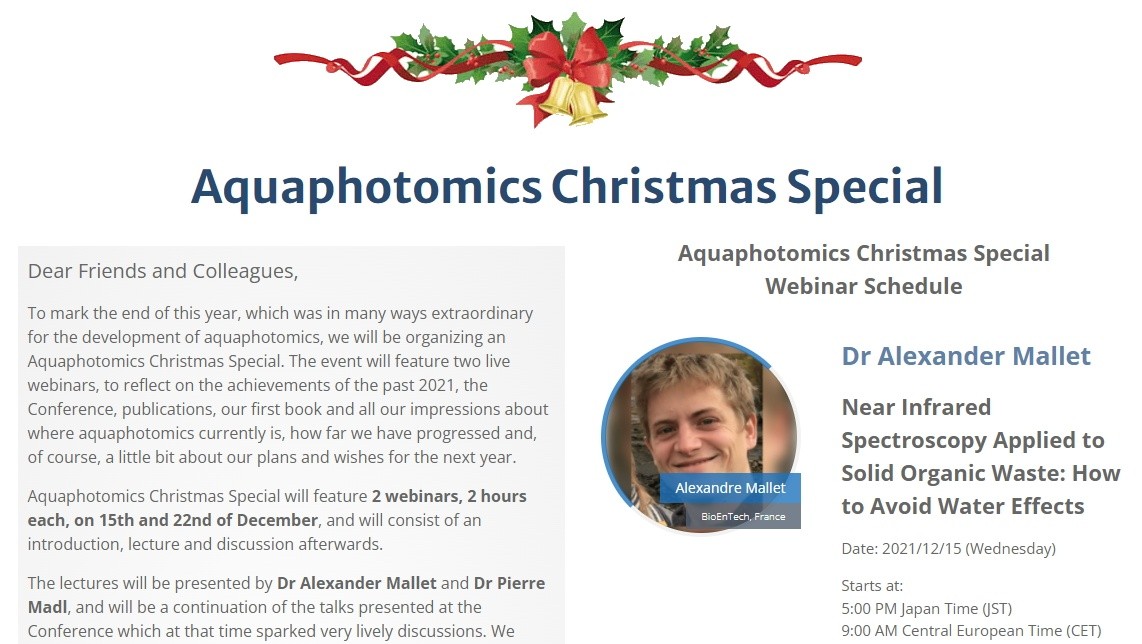
    To mark the end of this year, which was in many ways extraordinary for the development of aquaphotomics, we will be organizing an Aquaphotomics Christmas Special. The event will feature two live webinars, to reflect on the achievements of the past 2021, the Conference, publications, our first book and all our impressions about where aquaphotomics currently is, how far we have progressed and, of course, a little bit about our plans and wishes for the next year.

    Aquaphotomics Christmas Special will feature 2 webinars, 2 hours each, on 15th and 22nd of December, and will consist of an introduction, lecture and discussion afterwards.

    The lectures will be presented by Dr Alexander Mallet and Dr Pierre Madl, and will be a continuation of the talks presented at the Conference which at that time sparked very lively discussions. We hope that webinars will provide an opportunity to reignite the discussion spark and more time to address many questions that the topics generated.

    Please find the date and time of the webinars in the schedule. The webinars will be held using Zoom platform; free for all who wish to participate and with live transcription to Japanese. All you need to do is sign up for attendance using the form below.

    Finally, a Christmas will not be Christmas without presents. And as our Christmas present, we decided to make all the lectures from The 4th International Aquaphotomics Conference free for public. You can refresh your memories of how it all went in March, by watching a short digest video and find all the lectures and workshop on our Aquaphotomics YouTube channel.

    We are looking forward to seeing you at the Aquaphotomics Christmas Special!

    Aquaphotomics Christmas Special
    Webinar Schedule

    [amo_member id=”4548″ item-width=”150″ item-margin=”0″ full-width=”no” panel=”right” style=”2″]

    Dr Alexander Mallet

    Near Infrared Spectroscopy Applied to Solid Organic Waste: How to Avoid Water Effects

    Date: 2021/12/15 (Wednesday)

    Starts at:
    5:00 PM Japan Time (JST)
    9:00 AM Central European Time (CET)

    Ends at:
    7:00 PM Japan Time (JST)
    11:00 AM Central European Time (CET)

    [amo_member id=”4545″ item-width=”150″ item-margin=”0″ full-width=”no” panel=”right” style=”2″]

    Dr Pierre Madl

    Heretics or Pioneers: Viktor Schauberger and Wilhelm Reich – a Fresh Look

    Date: 2021/12/22 (Wednesday)

    Starts at:
    5:00 PM Japan Time (JST)
    9:00 AM Central European Time (CET)

    Ends at:
    7:00 PM Japan Time (JST)
    11:00 AM Central European Time (CET)

    If you have any questions, please contact us at info@aquaphotomics.com.

  • Video archive of “The 4th Aquaphotomics International Conference” is now open to the public !

    Video archive of “The 4th Aquaphotomics International Conference” is now open to the public !

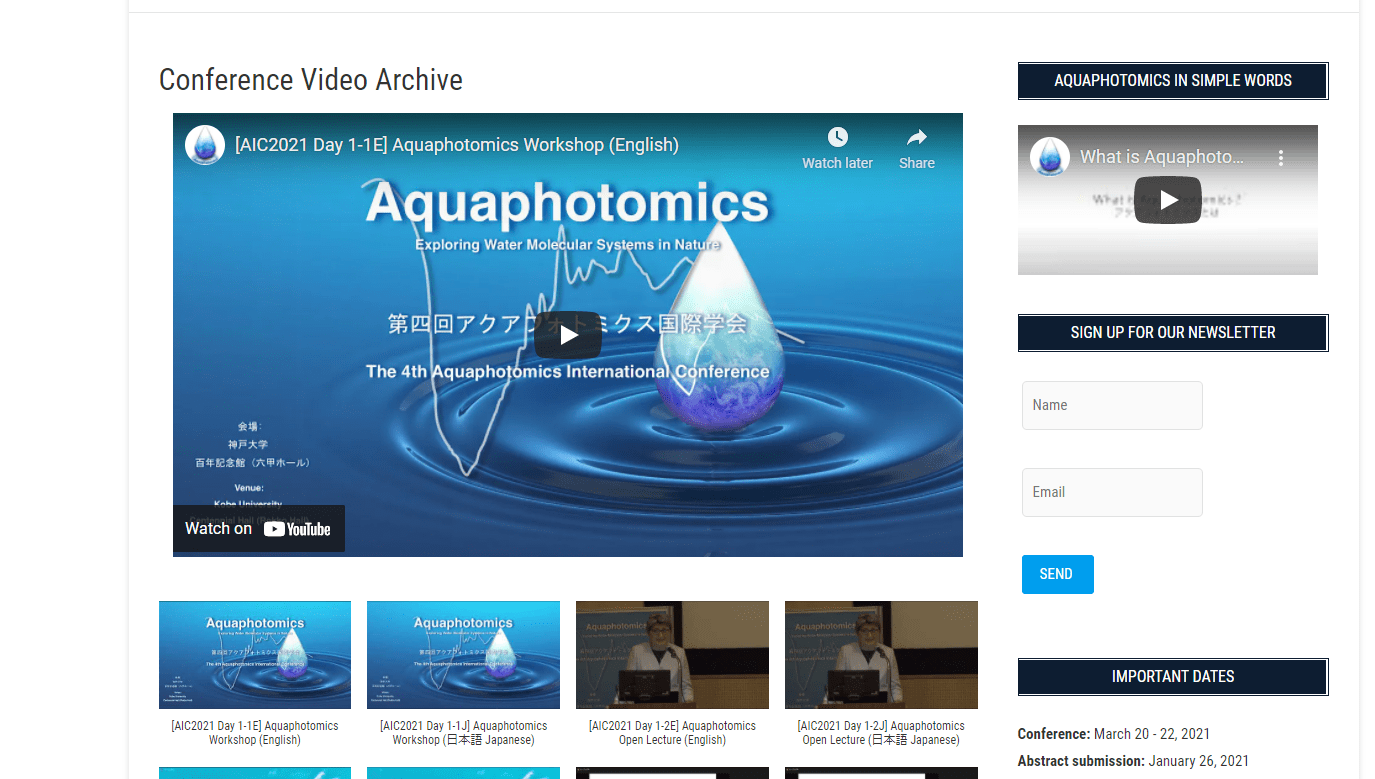
    We are very pleased to announce that the video archive for “the 4th Aquaphotomics International Conference” is now available for free on the conference website.

    https://aquaphotomics.com/Past/2021/conference-videos

    (Note: there are a lot of videos, so it may take some time to load the page.)

    Please contact us at conference@aquaphotomics.com if you have any questions.


    アクアフォトミクス国際学会
    参加の皆様へ

    この度はご参加いただきありがとうございます。

    「第4回アクアフォトミクス国際学会」のビデオアーカイブを公開しました。

    https://aquaphotomics.com/Past/2021/conference-videos

    (注:動画が多いので、ページの読み込みに時間がかかる場合があります。)

    質問がある場合は、conference@aquaphotomics.com までご連絡ください。

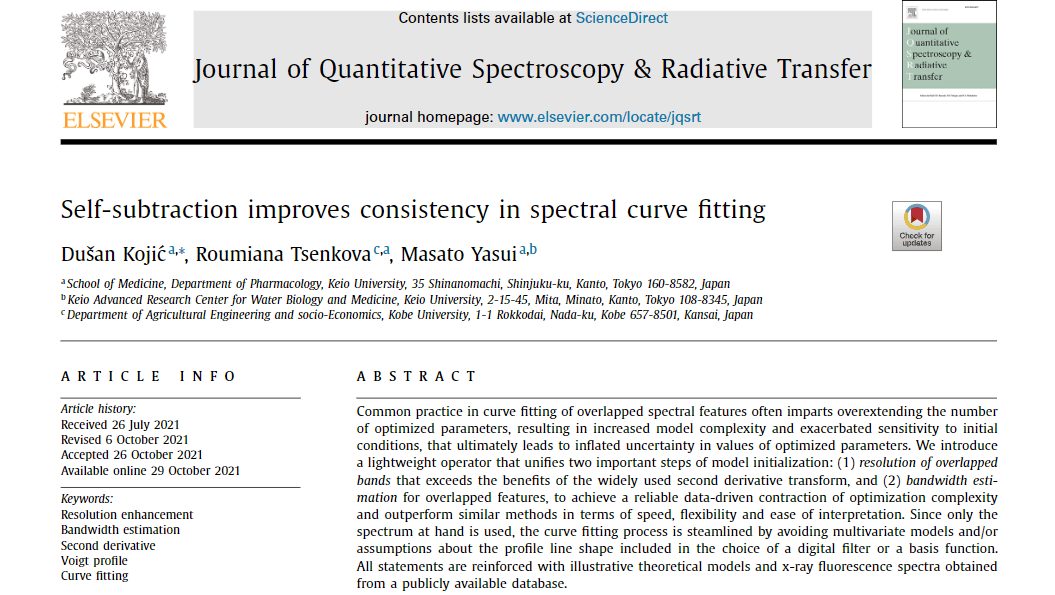
  • Self-subtraction improves consistency in spectral curve fitting

    Self-subtraction improves consistency in spectral curve fitting

    We are very pleased to announce that a new article on Aquaphotomics has been accepted and will be published in the “Journal of Quantitative Spectroscopy and Radiative Transfer” (Volume 277, January 2022, 107991).

    “Self-subtraction improves consistency in spectral curve fitting” by Dušan Kojić, Roumiana Tsenkova, and Masato Yasui

    Highlights
    • A purely functional algorithm for resolving positions and widths of overlapped bands is presented on the basis of self-subtracted spectra.
    • Significant improvements, demonstrated both theoretically and practically, over the popular second derivative transform are achieved.
    • The method eliminates any bias related to the choice of a basis function because it outputs the least-squares fit to the data.
    • Higher consistency with retained accuracy follow naturally from a systematic analysis of XRF spectra, across a variety of Voigt profile line shapes.

    The article can be viewed and downloaded at https://doi.org/10.1016/j.jqsrt.2021.107991.


    Recent News

  • Aquaphotomics for Bio-diagnostics in Dairy – First Aquaphotomics Book to be Published in December 2021

    Aquaphotomics for Bio-diagnostics in Dairy – First Aquaphotomics Book to be Published in December 2021

    The end of this year will mark an important step in aquaphotomics development on a global level. The first aquaphotomics book titled “Aquaphotomics for Bio-diagnostics in Dairy – Applications of Near-Infrared Spectroscopy” is scheduled to be published by Springer on December 11, 2021.

    The book is a result of more than 20 years of experience of working with near infrared spectroscopy in dairy and describes applications for measurement of raw milk components like fat, protein, lactose, urea and fatty acids. Further, it investigates factors that influence the accuracy of measurements like individuality of the dairy cow and then, for the first time, proceeds to establish the near infrared spectroscopy as a disease and bio diagnostics tool. The book shows that near infrared spectroscopy can be used for measurement of somatic cell count, mastitis diagnosis, estrus detection and other parameters of health and nutrition status of the animals thanks to the use of usually neglected water absorbance bands. These results present near infrared spectroscopy as a tool that provides a valuable feedback for dairy farm management and optimization of health status of animals.

    The book shows how the utilization of water absorption regions in near infrared spectra brought entirely new dimension to NIRS which led to recognition of informational value of water spectra and led to the development of aquaphotomics, a novel science whose foundation was exactly the dairy research work. With more than 20 chapters, describing in detail experimental work, the book offers easy replication of performed experiments and can serve as a guide for anyone interested in application of aquaphotomics for bio-diagnostics.

    The release of the book is schedule for 11th December, and can be found at the Publisher website page https://www.springer.com/gp/book/9789811671135. Since the publisher website is going to have a makeover in November, if the above provided link is not available, feel free to contact us for more information. Or you can preorder the book using the following links:

    Barnes & Noble:
    https://www.barnesandnoble.com/w/aquaphotomics-for-bio-diagnostics-in-dairy-roumiana-tsenkova/1140159927

    Google Books:
    https://books.google.co.jp/books/about/Aquaphotomics_for_Bio_diagnostics_in_Dai.html?id=Vn6izgEACAAJ&redir_esc=y

  • Aquaphotomics in simple words

    Aquaphotomics in simple words

    For all interested in aquaphotomics research and looking how to explain it to someone in simple words, we would like here to share an excellent short article, published at the beginning of this year as a part of news in Chemistry Research. The article Using light to reveal water impurities can be found at the following link:

    https://www.elsevier.com/physical-sciences-and-engineering/chemistry/journals/new-chemistry-research/using-light-to-reveal-water-impurities