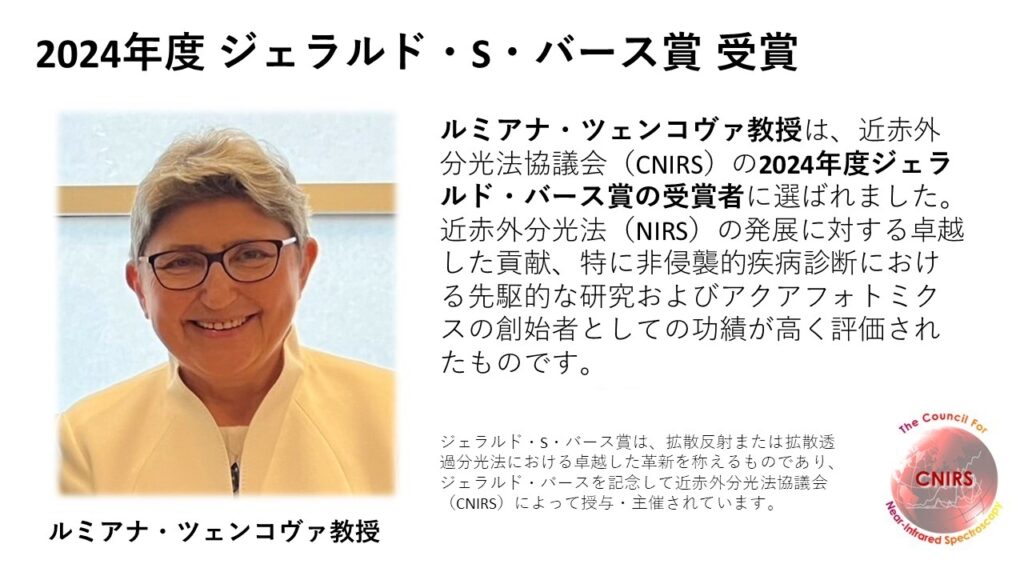
Gerald S. Birth賞は、拡散反射分光法または拡散透過分光法の分野における卓越した革新を称えるために、CNIRS(Council for Near-Infrared Spectroscopy, 近赤外分光学会評議会)によって授与される権威ある賞です。この賞は、国際拡散反射会議(IDRC)の創設者である Gerald S. Birth 博士 を記念して設立され、近赤外分光学(NIR)の技術と科学における重要な進展と貢献を祝うものです。
*1Malegori, C., Muncan, J., Mustorgi, E., Tsenkova, R. and Oliveri, P. Analysing the Water Spectral Pattern by Near-Infrared Spectroscopy and Chemometrics as a Dynamic Multidimensional Biomarker in Preservation: Rice Germ Storage Monitoring. Spectrochimica Acta Part A: Molecular and Biomolecular Spectroscopy (IF 4.4), p.120396, 2022. https://doi.org/10.1016/j.saa.2021.120396
初日の中心テーマはアクアフォトミクスの応用であり、イタリア・ジェノヴァのDIFAR大学のクリスティーナ・マレゴリ助教授によってさらに掘り下げられました。彼女の講演「Applications – Water is Everywhere(水は至るところにある)」では、多くの実践的な応用の可能性が紹介され、この分野における重要なノウハウが伝えられました。
応用に焦点を当てた講義の締めくくりとして、ガーナのクワメ・エンクルマ科学技術大学(Kwame Nkrumah University of Science and Technology)生物科学学部・食品科学技術学科の講師ジョン=ルイス・ジニア・ザクー博士が、「農業・食品分野におけるアクアフォトミクス」という講演を行いました。ザクー博士は、アクアフォトミクス研究者の「第3世代」に位置づけられ、ハンガリーでコヴァーチ教授の指導のもと博士課程を修了しました。なお、コヴァーチ教授自身もツェンコヴァ教授のポスドク研究員でした。博士号取得後、ザクー博士はガーナへ戻り、食品科学技術学科で実験室委員会委員長や試験補佐官を務めながら、ガーナにおける自身のアクアフォトミクス研究グループを立ち上げました。
彼女の最近の業績の一つに、博士論文「Non-destructive Spectroscopic Technology Applied to Sustainable Food Transformation Processes for Monitoring the Horticultural Supply Chain(園芸サプライチェーンのモニタリングのために持続可能な食品変換プロセスに適用された非破壊分光技術)」があります。この論文において彼女は、アクアフォトミクスとクラウドサービスを統合し、食品製品の品質を効率的に評価・監視できる革新的なクラウド型データベース「Aquacontrol」プラットフォームを創出したことを示しました。
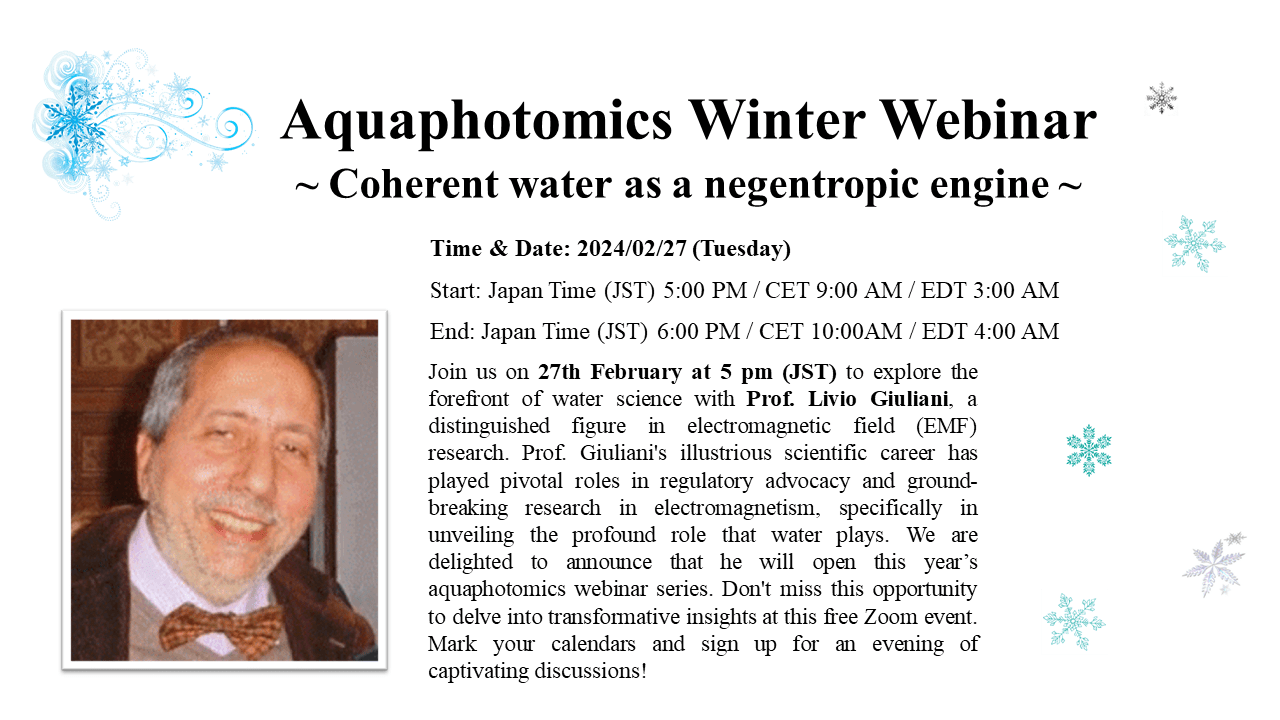
2つ目の基調講演は、ブリュッセルの欧州がん・環境研究センターを代表するリヴィオ・ジュリアーニ博士によって行われました。彼の講演「Exposure of iPSC-Cardiomyocytes to Ca2+-ICR Modulates Gene Expression According to Maturation Pathways」では、カルシウムのサイクロトロン共鳴に応答して遺伝子が上方制御および下方制御されるという説得力のある証拠が提示されました。ジュリアーニ博士は、この現象を「非電離」放射線が実質的に水を電離するという概念に基づいて画期的に説明しました。この電離プロセスは、細胞内の生化学反応を駆動するのに必要なエネルギーを持つコヒーレント水ドメインの形成につながるというものです。
Affiliation: Department of Zoology and Environmental Management, Faculty of Science, University of Kelaniya, Sri Lanka
Research Topics: Monitoring water quality in different environmental aspects, characterization of hazardous waste, environmental pollutions, Environmental toxicology, Comprehend soil characteristics and functionalities.
Our research group is currently immersed in several vital research areas:
Water Quality Monitoring: We are actively involved in monitoring the quality of water resources, both surface and underground. This includes assessing various parameters to ensure water safety and sustainability.
Analysis of Hazardous Environmental Pollutants: We are dedicated to identifying, analyzing, and mitigating hazardous environmental pollutants, safeguarding both natural ecosystems and human health.
Soil Degradation and Water Table Depletion: We are committed to studying the impact of diverse factors on soil degradation and the depletion of water tables. Our aim is to develop strategies for sustainable land use and water resource management.
Biological Characteristics Assessment: We conduct comprehensive research on the biological characteristics of animals, fish, and insects throughout their growth cycles. This encompasses evaluating the influence of environmental and human-induced factors on these populations.
Waste Byproducts and Bio-Product Innovation: Our research also focuses on finding solutions for different waste byproducts. Simultaneously, we seek to innovate new bio-products that are not only economically profitable but also environmentally friendly.
With the integration of Aquaphotomics into our research framework, we anticipate a significant expansion in our research horizons. This integration will bring a fresh perspective to our methodologies, data analysis techniques, and the interpretation of our research results. We believe that Aquaphotomics will be a valuable addition to our research toolkit, allowing us to gain deeper insights and enhance the impact of our work in these crucial areas.
We are excited about the potential that Aquaphotomics offers and look forward to the valuable contributions it can make to our ongoing research endeavors.
Aquaphotomics work:
My pioneering journey with Aquaphotomics began in August 2022 when I joined the Aquaphotomics research group as a Post-Doctoral Researcher at Kobe University in Japan. Together with the Aquaphotomics research team, we embarked on introducing Aquaphotomics and NIR spectroscopy as highly efficient and practical tools for comprehending soil characteristics and functionalities in both on-site and in-situ settings. Our collaborative efforts extended to conducting a diverse range of experiments at the Yunosato lab. One of our key focuses was the monitoring of Yunosato mineral waters over time to meticulously assess the consistency and variances in their water characteristics. In addition, we delved into the evaluation of various water sample types, including N power, zero power, extracted bio-functional water, and treated sewage water. Our goal was to gain a deeper understanding of their unique water characteristics and functionalities, utilizing the power of Aquaphotomics. Furthermore, we initiated a comprehensive study of soil-plant responses, precisely tracking and evaluating their interactions and compatibility throughout different stages of plant growth. Collaborating closely with the research team, we set out to assess soil-tested parameters using Aquaphotomics, referencing the values obtained from the Photo-nutrient analyzer.
With the strong support of the Aquaphotomics team and upcoming research collaborations with the Department of Agrobioscience at Kobe University, our future research endeavors are poised to explore Aquaphotomics as a groundbreaking and holistic approach for the investigation of soil properties and functions. Our ultimate aim is to contribute to the development of a soil aquaphotome, further enhancing our understanding of the intricate world beneath our feet.
Currently, we function as a dedicated research team affiliated with the Department of Zoology and Environmental Management within the Faculty of Science at the University of Kelaniya. Our extensive knowledge and substantial contributions to Aquaphotomics and other environmental research conducted in Japan are expected to bring immense value to our future research initiatives within the department.
そして未来に目を向ければ、次回の再会は2025年6月8日から12日、イタリア・ローマで開催されるNIR2025です。本会議は「光の世紀を超えて(Light through Centuries)」をテーマとして掲げ、アクアフォトミクスセッションもその重要な一部となる予定です。ローマで皆さまと再びお会いできることを心より楽しみにしております!